









































Author: Mycond Technical Department
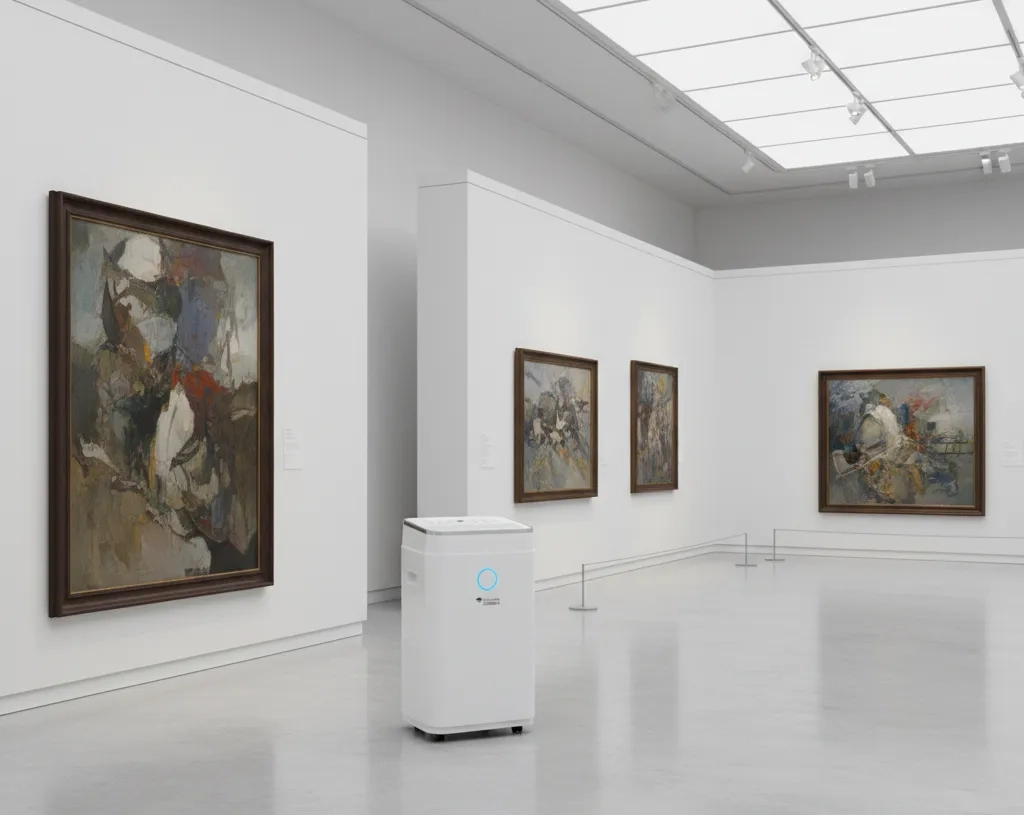
A properly designed air dehumidification system is a key element in ensuring the correct microclimate in museum and archive spaces. The preservation of cultural assets, historical documents and unique exhibits directly depends on maintaining optimal humidity and temperature parameters. In this article, we examine in detail the engineering approach to designing dehumidification systems, the technical aspects of moisture balance calculations, and the specific requirements for different types of spaces.
Regulatory requirements for the microclimate of museum and archive spaces
Different types of exhibits require specific temperature and humidity regimes for optimal preservation. Paper and documents are best preserved at 18-22°C and a relative humidity of 50-55% RH. For wooden furniture, the optimal range is 18-22°C and 45-55% RH. Metal exhibits and weapons require lower humidity levels of 35-45% RH at a temperature of 15-20°C. Textiles and fabrics are stored at 18-20°C and a relative humidity of 50-55% RH. Paintings on canvas are best preserved at 18-22°C and 50-55% RH, whereas photographs and film materials require special conditions: 15-18°C at 30-40% RH.
For most materials, the regulatory range of relative humidity is 40-55% RH, but for sensitive exhibits this range may be narrower. Permissible daily temperature fluctuations should not exceed 2-3°C, and humidity fluctuations should not exceed 5-7% RH, to avoid thermal deformation and damage to materials. The rate of change of parameters, especially during seasonal adjustment, should be gradual – no more than 3-5% RH per week.
It is important to understand the difference between exhibition halls, where visitor comfort must be ensured, and archive repositories, where the priority is the preservation of documents. Psychrometric charts are used to define target microclimate parameters, allowing the determination of comfort zones for exhibits of different types.
The regulatory framework for design includes ISO 11799 for archives, ASHRAE Chapter 24 recommendations for museums and the European standard EN 15757 for cultural heritage.
Specifics of archive repositories compared to exhibition halls
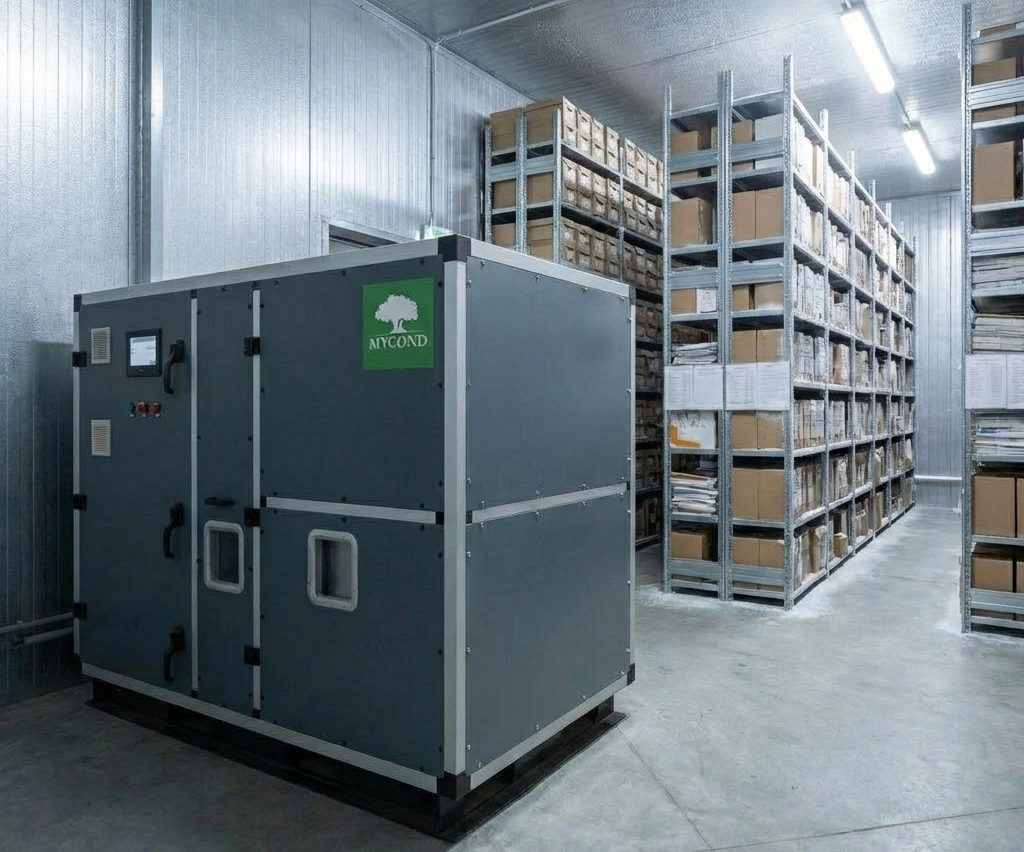
Archive repositories and exhibition halls differ significantly in operating regime. Archives experience infrequent access to rooms, unlike exhibition halls with a constant flow of visitors. Temperature regimes also differ: archives maintain a lower temperature (15-18°C) to slow down material degradation processes.
Humidity requirements for archival documents are usually lower (40-50% RH) than for exhibition exhibits. The absence of moisture emissions from visitors in archives simplifies moisture balance calculations. However, archive repositories have higher requirements for parameter stability – permissible humidity fluctuations should not exceed ±3% RH.
For archives with unique documents, redundancy of air-conditioning and dehumidification systems is critically important. Air infiltration also affects these spaces differently: archive rooms usually have better airtightness, although basement archives may suffer from elevated humidity.
Particular attention should be paid to the choice of dehumidification system for cold archives with temperatures below 15°C. Under such conditions, adsorption dehumidification systems are most effective, as condensation systems lose capacity at low temperatures.
Components of the moisture balance of a museum space
The key component of the moisture balance of a museum space is infiltration – uncontrolled ingress of outdoor air through building envelopes, windows, doors, joints and cracks. This factor is particularly important for historic buildings with low airtightness.
The infiltration calculation method is based on determining the difference in moisture content between outdoor and indoor air and the air change rate of the space. Moisture emissions from visitors are another important factor, which depends on the number of people, their dwell time (typically 30-90 minutes) and their activity level. Specific moisture emissions from one adult are 40-80 g/h depending on activity and indoor temperature.
Exhibits also affect the moisture balance through the processes of sorption and desorption of moisture. Hygroscopic materials such as wood, paper and textiles can absorb moisture when the air humidity rises or release it when it falls. Moisture exchange processes are inertial and can last for hours or even days, creating a buffering effect.
The humidity of supply air from the ventilation system also affects the overall balance and must be taken into account when calculating the capacity of the dehumidification system. Condensation on cold surfaces (display case glass, external walls, uninsulated pipes) can occur if their temperature is below the dew point of the air in the room.
A step-by-step algorithm is used to determine the total moisture load: calculate infiltration (difference in moisture content × air change rate), add moisture emissions from visitors (number × specific emissions), account for the humidity of ventilation supply air, and assess moisture exchange with exhibits.
It is important to consider seasonal changes in the moisture balance: in summer, a typical problem is excess moisture due to infiltration, while in winter there may be over-drying of the air.
Choosing the type of dehumidification system for museum conditions
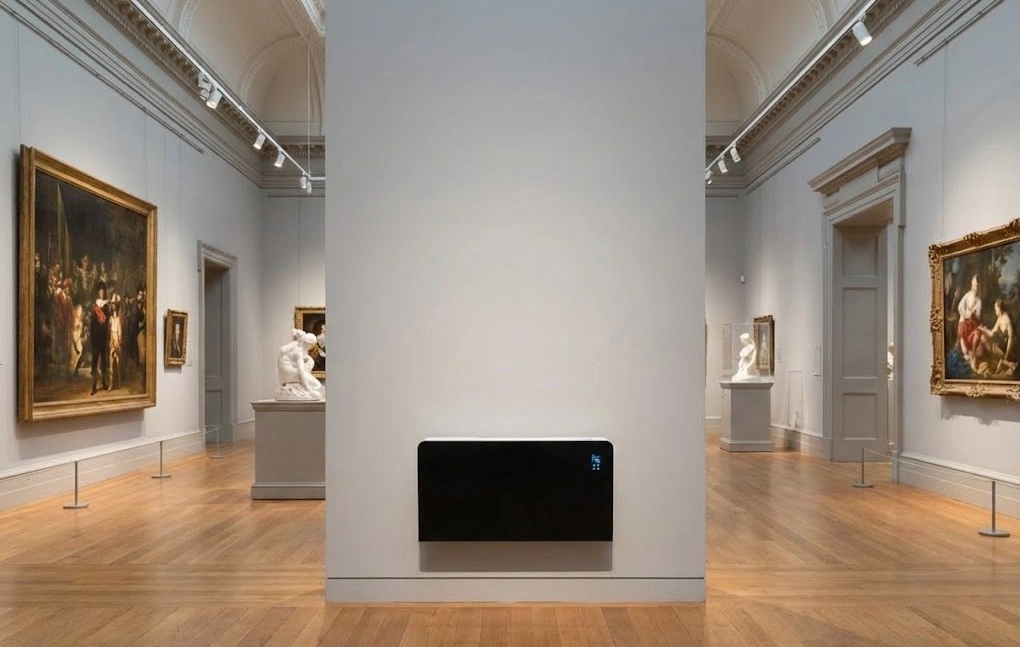
The choice between condensation and adsorption dehumidification systems depends on several criteria: room temperature, target humidity, and energy efficiency requirements. Condensation dehumidification operates by cooling air below the dew point, condensing the moisture and then reheating the air. However, the efficiency of such systems drops sharply at temperatures below 15°C, and at temperatures below 5°C there is a risk of heat exchanger icing.
The advantages of condensation systems are high energy efficiency at moderate temperatures (coefficient of performance, COP, 2-4) and relatively low cost. Adsorption dehumidification is based on the principle of absorbing moisture by a special adsorbent with subsequent regeneration of the adsorbent using heated air.
Adsorption systems are best used in cold archives with temperatures below 15°C or when the target humidity is below 35% RH. Their key advantage is stable performance regardless of temperature. However, the energy consumption of adsorption systems is higher compared to condensation systems (COP 0.5-1.5).
When choosing between standalone dehumidifiers and a centralised system, consider the room volume (threshold 500-1000 m³ for standalone systems), the number of climate zones and service accessibility. Standalone systems offer ease of installation, precise zoning and redundancy (failure of one unit does not lead to total system failure). Centralised systems provide a single point of maintenance, the possibility of heat recovery and integration with a building management system (BMS).
It is important to correctly integrate the dehumidification system with existing ventilation and air-conditioning systems, supplying dehumidified air into the ventilation ducts and coordinating operating modes. Under certain conditions, it is advisable to recover condensation heat to preheat supply air or for hot water supply.
Calculating dehumidification system capacity
Determining the required capacity of the dehumidification system starts with understanding the mass capacity in terms of moisture, measured in kg/h or l/day (1 litre of water corresponds to 1 kg). The calculation is based on the moisture balance of the space, which includes summing all sources of moisture ingress.
The capacity calculation formula can be expressed verbally as follows: capacity equals the sum of moisture gains from infiltration, visitors, ventilation and other sources. In the calculation, it is necessary to consider the operating mode of the system – continuous (24/7) for archives or intermittent for museums during their opening hours.
It is recommended to apply a capacity safety factor of 1.15-1.25 to compensate for unforeseen factors, load unevenness and declining equipment performance over time. This margin is justified by the need to account for peak attendance, door-opening events and seasonal humidity maxima.
For a verification calculation, a psychrometric chart is used according to the following algorithm: determine the initial state of the air (temperature, humidity), find the final state after dehumidification (target humidity), check whether the difference in moisture content corresponds to the calculated capacity, and ensure that the target parameters are achievable at the given temperature.
Consider a numerical example for an exhibition hall with a volume of 500 m³ at a temperature of 20°C and a target humidity of 50% RH, when outdoor summer conditions are 26°C and 70% RH. With an air change rate of 0.5 h⁻¹ and a difference in moisture content between outdoor (15 g/kg) and indoor (7.3 g/kg) air, and with 50 simultaneous visitors with specific moisture emissions of 60 g/h per person, the total capacity can be calculated taking into account the safety factor.
The capacity of the dehumidification system depends on outdoor air temperature, leading to seasonal load variations. In summer, continuous operation is usually required, while in winter it may be possible to switch off the system at low outdoor humidity.
Thermal balance of the space during dehumidifier operation
When a dehumidification system operates, a significant amount of heat is released, affecting the thermal balance of the space. During condensation of moisture, latent heat of vaporisation is released, which is approximately 2500 kJ/kg of moisture or 0.7 kWh/kg. The thermal load from the condensation process is calculated as the product of dehumidification capacity and the specific latent heat of vaporisation.
The compressor of a condensation dehumidifier also releases heat, as the electrical power of the compressor is fully converted into thermal energy. In adsorption dehumidifiers, heat gains are associated with the operation of the heater for adsorbent regeneration, and part of this heat is transferred to the room air.
The overall thermal balance also includes heat gains from visitors (80-120 W per person depending on activity), lighting (the power of luminaires is practically entirely converted into heat) and through building envelopes (walls, ceiling, floor) in the warm season.
With intensive dehumidification in summer, the total thermal load can reach 5-10 kW for a medium-sized hall, creating the need for additional cooling of the space. The methodology for determining the thermal balance includes the following steps: determining heat gains from condensation (capacity × latent heat of vaporisation), adding compressor or heater power, accounting for heat gains from visitors, lighting and building envelopes, and comparing the total load with the cooling capacity of the air-conditioning system.
Integration of the dehumidification system with the requires coordination of operating modes to avoid simultaneous heating and cooling of the air. Uncoordinated operation of these systems leads to significant energy losses: the dehumidifier heats the air while the air conditioner cools it, causing double energy consumption.
Equipment placement and air distribution
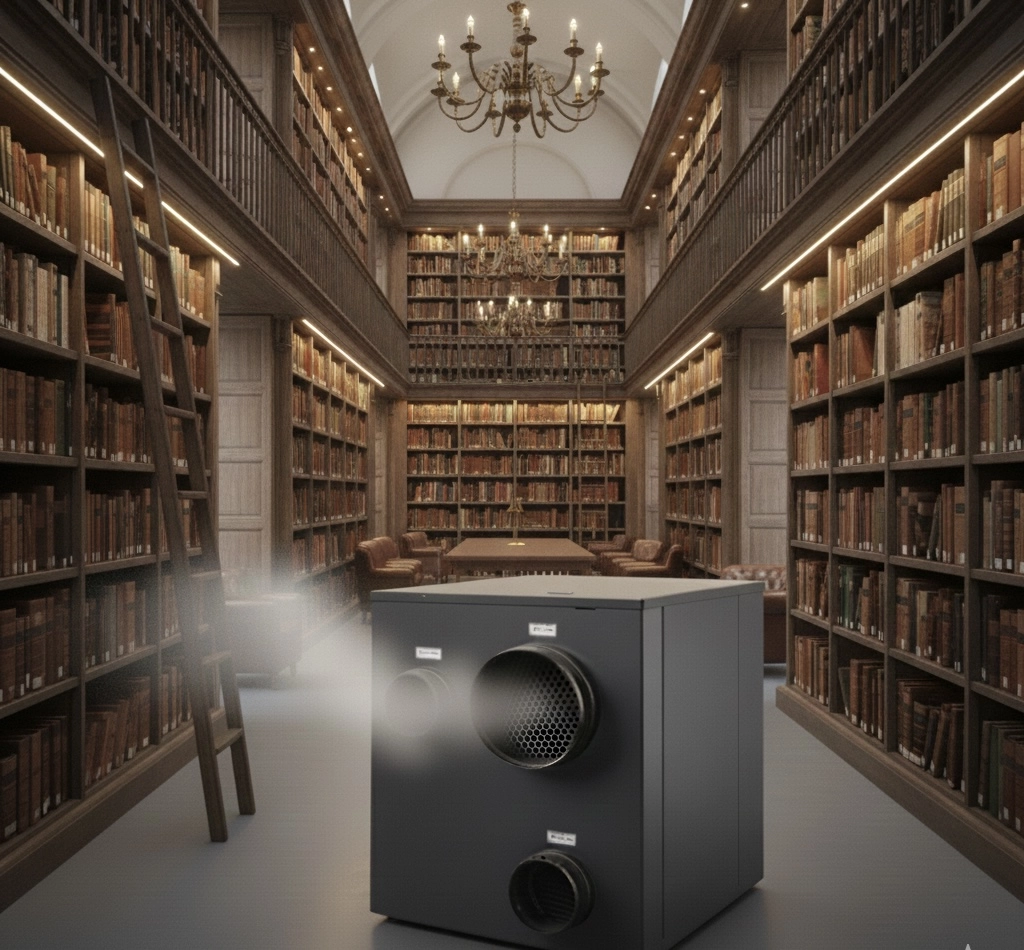
Correct placement of dehumidifiers and organisation of air distribution have a decisive impact on system efficiency. The location of the dehumidifier should ensure free air circulation, service accessibility and minimal noise for visitors. The recommended minimum distance from walls and other obstacles is 0.5-1.0 m to ensure air access to the intake opening.
Standalone units are usually installed on the floor, while centralised systems can be installed under the ceiling. When organising air circulation in the room, it is important to avoid stagnant zones and ensure even distribution of dehumidified air.
Typical placement mistakes include installing the dehumidifier in a corner without proper circulation or behind a partition that blocks the airflow. Temperature and humidity sensors should be placed at the level of the exhibits (1.0-1.5 m from the floor) in a zone with stable parameters, away from doors and windows. To ensure proper control, it is recommended to install at least one sensor per 100-150 m² of area, and in critical repositories – additional monitoring points.
Condensate drainage should be arranged with the possibility of gravity discharge into the sewer or with a condensate pump if the necessary slope is absent. For centralised systems, it is important to ensure heat removal from the dehumidifier through the ventilation system of the plant room.
Control and monitoring systems for microclimate parameters
An effective microclimate control system requires the correct selection of temperature and humidity sensors with a measurement accuracy of no worse than ±2% RH for museum conditions. Important characteristics include measurement range, stability and the ability to calibrate. Sensor calibration is recommended annually, and for critical applications – verification using reference instruments.
Data collection and archiving systems should provide parameter logging at 10-30 minute intervals and store data history for years. Various algorithms are used to control the dehumidification system: a simple hysteresis controller (switch-on when exceeding the upper limit, switch-off at the lower limit) or more complex PID control systems with smooth capacity modulation.
The hysteresis band usually ranges from 3-5% RH, which avoids frequent switching and equipment wear. Systems with PID control provide increased accuracy of parameter maintenance (±1-2% RH).
Integration with a building management system (BMS) provides remote monitoring, alarm notifications and trend analysis. Data visualisation in the form of temperature and humidity graphs (daily, weekly, seasonal) helps detect anomalies and optimise system operation.
Emergency signalling should report parameters exceeding permissible limits, equipment failure or condensate tank overflow. Analysis of system performance includes comparing actual energy consumption with calculated values and assessing payback periods.
Operating modes and seasonal adjustment
The operating modes of air dehumidification systems require seasonal adjustment. In summer, when outdoor humidity is high, intensive dehumidification is necessary and the system may operate around the clock (24/7). In winter, with low outdoor humidity, dehumidification intensity can be reduced or the system switched off, and in some cases humidification may even be required, especially when the heating system is running.
In the shoulder seasons (spring, autumn) variable moisture loads are observed, requiring flexible adjustment of system capacity. For exhibition halls, a night mode may be used with reduced dehumidification intensity in the absence of visitors, while maintaining stable parameters.
The weekend operating mode should take into account changes in visiting schedules with appropriate correction of controller setpoints. It is important to ensure automatic increase in dehumidification intensity during peak visiting hours.
When seasonally changing parameters, it is critically important to proceed gradually: it is recommended to change setpoints by no more than 3-5% RH per week to avoid exhibit deformation. Regular maintenance includes monthly filter cleaning, quarterly compressor checks and replacement of the adsorbent every 2-5 years depending on operating conditions.
Frequently asked questions
What is the target relative humidity for different types of exhibits and why is it impossible to set a single value for the entire museum?
Different materials have different optimal humidity ranges: metal requires 35-45% RH to prevent corrosion, wood 45-55% RH to avoid cracking, and paper 50-55% RH to preserve fibre flexibility. Setting a single humidity value is impossible due to conflicting requirements. The optimal solution is zoning by exhibit type with separate control systems for each zone.
How can visitor moisture emissions be accurately accounted for when calculating dehumidification capacity?
The methodology includes determining the average number of visitors per hour (based on statistics or design data), multiplied by their dwell time in the hall (typically 0.5-1.5 hours) and specific moisture emissions (40-80 g/h per person depending on temperature and activity). For example, for 50 people staying in the hall for 1 hour with emissions of 60 g/h, the total moisture ingress will be 3 kg/h.
Why are condensation dehumidifiers ineffective in cold archive repositories and when are adsorption systems mandatory?
At temperatures below 15°C the capacity of condensation dehumidifiers drops sharply due to the lower saturated vapour pressure, and below 5°C evaporator icing occurs. Adsorption systems provide stable capacity regardless of temperature thanks to the physico-chemical moisture absorption process. Adsorption systems become economically justified at a constant temperature below 12-15°C.
How to determine the need to integrate the dehumidification system with air-conditioning and when can the systems operate independently?
Integration is mandatory when the total thermal load from dehumidification exceeds 3-5 kW and excess heat needs to be removed from the room. Independent operation is possible in cold archives (15-18°C) and in the shoulder seasons at moderate temperatures. A practical criterion: if dehumidifier operation raises the room temperature by more than 1-2°C above the target, additional cooling is required.
What specific consequences for exhibits can arise from insufficient or excessive dehumidification system capacity?
Insufficient capacity leads to humidity levels above 60-65% RH, creating conditions for mould growth, biological corrosion, condensation on cold surfaces and swelling of wood and paper. Excessive capacity reduces humidity below 35-40% RH, causing paper embrittlement, wood cracking and delamination of paint layers in artworks. Both errors significantly shorten exhibit lifespans.
Conclusions
Designing an air dehumidification system for museums and archives requires a comprehensive approach that includes analysis of regulatory requirements, detailed calculation of moisture and thermal balances, as well as zoning by exhibit type. The choice of system type (condensation or adsorption) critically depends on room temperature, with a threshold of 12-15°C beyond which the effectiveness of condensation systems decreases significantly.
Capacity calculations must be based on a detailed analysis of all components of the moisture balance: infiltration, visitor emissions and ventilation, with mandatory application of a 1.15-1.25 safety factor. The thermal balance of the space must not be ignored at the design stage, as condensation heat and compressor operation create a significant thermal load (5-10 kW for a medium-sized hall), requiring coordination with the air-conditioning system.
Typical design errors include incorrect system type selection, underestimation of visitor moisture emissions, ignoring infiltration, and lack of zoning and redundancy. Proper equipment placement and air distribution directly affect system efficiency, preventing the formation of stagnant zones.
Control and monitoring systems are an integral part of modern museum systems, providing continuous parameter recording at 10-30 minute intervals to detect deviations and optimise operating modes. The energy efficiency of dehumidification systems varies significantly: condensation systems consume 0.3-0.6 kWh/kg of moisture, adsorption systems 0.7-1.5 kWh/kg, which must be taken into account when selecting a system considering both capital and operating costs.
The results of implementing dehumidification systems confirm their effectiveness: stabilising humidity within ±3-5% RH instead of fluctuations of ±10-15% RH reduces exhibit ageing rates by 2-3 times. However, one should remember the limits of calculation methodologies, temperature constraints and the uncertainty of infiltration in historic buildings, necessitating in-situ measurements before design.


