










































Author: Mycond Technical Department
Designing humidity control systems is one of the most challenging tasks in HVAC, as it addresses a fundamental contradiction: humidity requirements for different functional zones of a building are often incompatible, while it is economically impractical to design separate systems for each zone. The engineering solution lies in justified zoning and differentiation of requirements, taking into account the criticality of parameters. This approach helps avoid both excessive capital expenditure and operational issues associated with uncontrolled humidity.
Air humidity is the amount of water vapour present in the air. There are two main indicators: absolute humidity (the number of grams of water vapour per cubic metre of air, g/m³) and relative humidity (the percentage ratio of the actual moisture content to the maximum possible at a given temperature). A critical characteristic is that the maximum amount of moisture that air can hold depends on temperature—the warmer it is, the more water vapour can be held.
For illustration: air at 24°C and 50% relative humidity contains approximately 10.8 g/m³ of moisture. If the surface temperature in the room drops to 13°C (which can occur on cold windows or thermal bridges), condensation will start to form on it, as 13°C is the dew point for these conditions. These parameters are provided to explain the physics of the process; actual project design uses real project data.
Humidity directly affects the durability of materials. Hygroscopic materials, such as timber structures, change their dimensions and mechanical properties depending on ambient humidity. According to engineering practice, a 10% change in humidity can lead to a 0.5–1.5% change in the linear dimensions of wood, which is critical for high-precision joinery. The specific magnitude depends on the type of wood and operating conditions. Metals are prone to corrosion at high humidity, especially when relative humidity exceeds 60% and pollutants are present. Electronic components suffer due to condensation and the build-up of static electricity.

Regulatory framework
Modern humidity requirements are based on several international standards. According to EN 16798-1:2019, the indoor environment of buildings is divided into four quality categories (from I to IV), where category I corresponds to the highest quality and the narrowest humidity ranges. For category I the range of relative humidity is 30–50% in winter and 30–50% in summer; for category II it is 25–60% throughout the year.
ISO 7730 focuses on thermal comfort and offers an integrated approach, where humidity is considered as one of the factors of thermal comfort along with temperature, air velocity, and mean radiant temperature.
ASHRAE Standard 55 introduces the concept of adaptive comfort, which takes into account people’s ability to adapt to changing environmental conditions. Humidity values are considered differently for winter and summer modes, as people perceive humidity differently at different temperatures.
To illustrate the effect of temperature on absolute humidity: at 20°C and 50% relative humidity, absolute humidity is approximately 8.7 g/m³, whereas at 25°C and the same relative humidity of 50%, absolute humidity increases to 11.5 g/m³. This demonstrates the importance of understanding absolute humidity for ventilation systems, as when air is heated its relative humidity decreases, and when cooled it increases, although the absolute moisture content remains unchanged.
The methodology for design parameters often relies on statistical approaches. For example, for dehumidification systems, design parameters are used that correspond to conditions occurring no more than 1–5% of the time during the year, depending on the criticality of the facility.
Commercial buildings
In design practice for office spaces, relative humidity ranges of 30–60% in winter and 40–60% in summer are often considered. Specific limits are set by the designer depending on regulations, available equipment, and operating conditions. At low humidity (below 30%) users may experience discomfort—dry skin, irritation of mucous membranes, and an increased risk of static build-up. At high humidity (above 60%) favourable conditions are created for the development of micro-organisms.
To illustrate the calculation method: consider an office of 100 m² with 10 employees. Moisture emission from one person at moderate activity is approximately 50–70 g/h. With an air exchange of 500 m³/h, outdoor air with an absolute humidity of 9 g/m³ and a target indoor humidity of 10.5 g/m³ (50% at 24°C), the system must compensate for the difference between moisture gains and removal. This example demonstrates the approach to calculation; the method is applied with real data from the specific project.
For offices, the main humidity load often comes from outdoor air, especially in summer in humid climates, when ventilation air needs not only cooling but also dehumidification.
In shopping centres, it is important to consider zonal differences. Grocery sections with open refrigerated display cases create zones with reduced surface temperatures, which increases the risk of condensation if indoor relative humidity exceeds the design value. The surface temperature of refrigeration equipment may be below the dew point of the surrounding air, leading to condensation and ice formation.
In hotels, special attention is paid to kitchens with high technological moisture emissions and conference rooms with high occupancy density. A typical design error is applying a universal approach to the entire building, underestimating peak loads, and a lack of zoning.
Industrial facilities
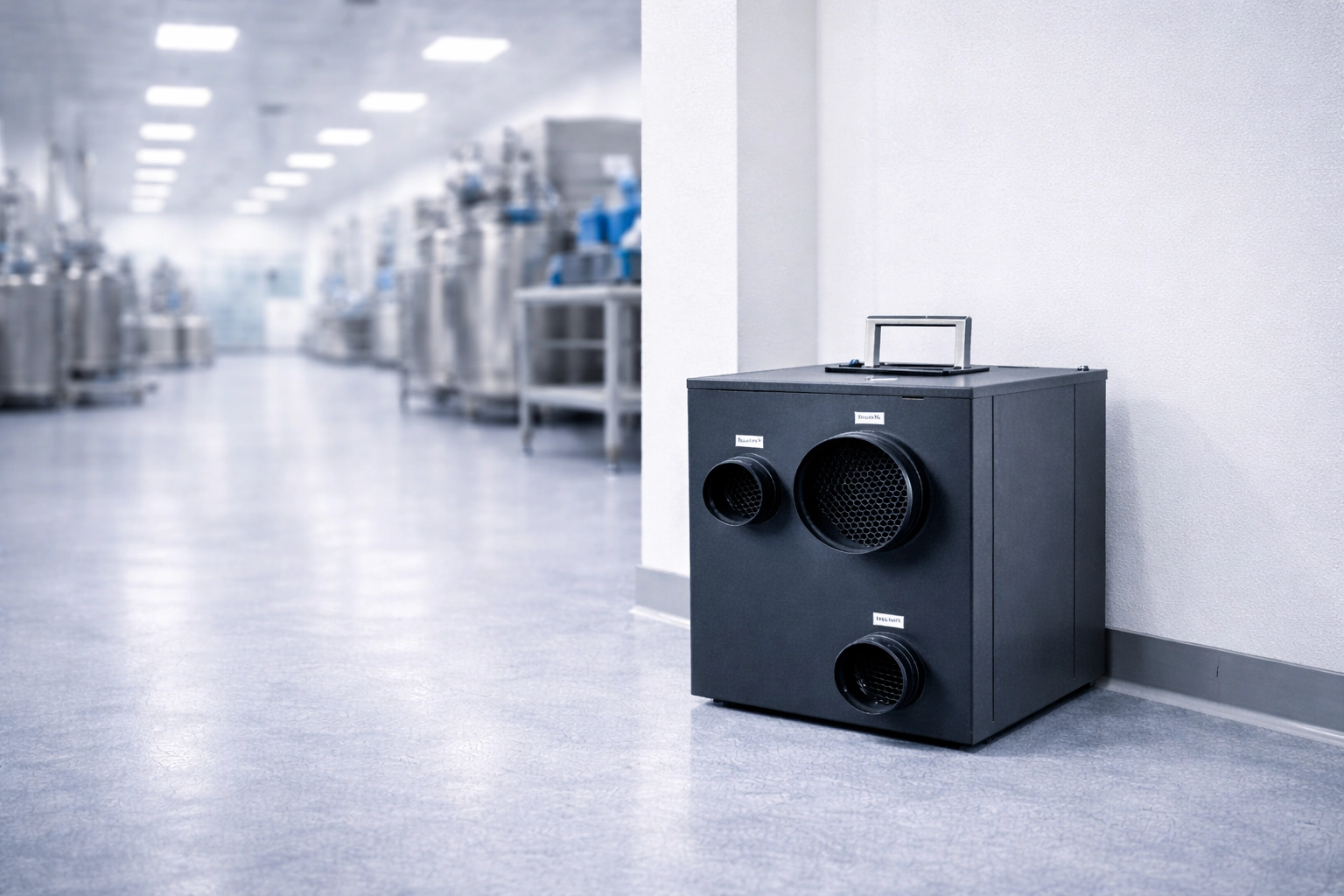
Humidity control in pharmaceutical production is critically important. For cleanrooms, according to ISO 14644-1:2015 and GMP Annex 1 (2020), strict requirements are set for the stability of microclimate parameters. In pharmaceutical practice, tolerances of ±5% relative humidity from the set value are encountered. Specific parameters are determined by the designer in accordance with process requirements.
The criticality of humidity control is explained by its impact on hygroscopic pharmaceutical powders, which can change their properties with humidity fluctuations, leading to product defects.
For illustration, consider a production room with an area of 200 m² and a volume of 600 m³, where it is necessary to maintain a relative humidity of 45±5%. At a temperature of 21°C, this corresponds to an absolute humidity of 7.2–8.8 g/m³. With an air exchange of 10 air changes per hour (6000 m³/h) and a maximum absolute humidity of outdoor air of 15 g/m³, the dehumidification system must provide removal of up to 42 kg of moisture per hour. The calculation demonstrates the methodology; in the project all data are taken from the technical specification.
In the food industry, humidity requirements vary significantly depending on the technology. In drying shops, understanding the physics of partial pressures is important—the drying rate directly depends on the difference between the partial pressure of water vapour in the product and in the surrounding air. In bakeries, process requirements may stipulate increased humidity at certain production stages.
For storage facilities, the key is to prevent product spoilage. In cold rooms, it is critically important to control the dew point of incoming air to avoid frost formation on evaporators.
In electronics manufacturing and photolithography, humidity directly affects process accuracy. Static electricity, which develops at low humidity, can damage sensitive components. Economic consequences of defects in such production are especially significant due to the high cost of components.
The textile industry requires humidity control to prevent fibre breakage. In the woodworking industry, the equilibrium moisture content of wood depends on ambient humidity, which affects processing quality and the dimensions of finished products.
When designing storage facilities, it is important to consider evaporation from the surfaces of wet materials, which can create an additional load on dehumidification systems.
Institutional facilities
Humidity in hospitals, especially in operating theatres, is regulated according to medical standards. According to ASHRAE Standard 170-2017, a relative humidity range of 20–60% is established for operating rooms. In hospital design practice, narrower ranges may be encountered, specifically defined by the designer depending on national regulations and the type of operations.
When determining requirements, it is important to consider the balance between preventing static electricity (which requires increased humidity) and limiting the development of micro-organisms (which requires reduced humidity).
For illustration: an operating theatre with an area of 50 m² and an air exchange of 1500 m³/h requires maintaining a relative humidity of 50±5% at a temperature of 20°C. This corresponds to an absolute humidity of 7.3–8.7 g/m³. With outdoor air at an absolute humidity of 12 g/m³, the system must remove up to 6.5 kg of moisture per hour. In winter, with outdoor absolute humidity at 2 g/m³, humidification is required to achieve the target parameters.
In educational institutions, humidity affects pupil comfort and the quality of the learning process. Research indicates that low humidity correlates with reduced concentration.
Museums and archives have specific humidity requirements for preserving exhibits. According to museum conservation data, for most paper documents and paintings a stable relative humidity of 45–55% is optimal. Different exhibits have different requirements, which often creates conflict in air-conditioning systems.
Physical mechanisms of degradation include cyclic stresses in materials due to humidity changes, which is particularly critical for antique wooden objects and panel paintings on wooden supports. Mould growth is activated at relative humidity above 65% and a temperature of 20–30°C.

Sports facilities
In pool design practice, relative humidity ranges of 50–65% are encountered. Specific parameters depend on equipment type, national regulations, and the purpose of the pool. The physics of evaporation from the water surface is decisive for calculating moisture gains.
For illustration: a pool measuring 25×10 m (water surface area 250 m²) at a water temperature of 28°C and an air temperature of 30°C will have an approximate evaporation rate of about 50 kg/h with low swimmer activity. According to ASHRAE 2007 HVAC Applications, evaporation is calculated taking into account actual visitor numbers, activity, and the difference in water vapour pressure over the water surface and in the air. The methodology is applied with actual project data.
To prevent condensation on cold surfaces (glazing, metal structures), the temperature of interior surfaces must be above the dew point of the indoor air. Corrosion of metal elements in the humid pool environment is accelerated, especially in the presence of chlorinated compounds.
In sports halls and spa complexes, different zones with different parameters need to be considered. Ice arenas present a particular challenge due to the combination of low ice surface temperatures and the need to maintain comfortable conditions for spectators.
Data centres
According to the recommendations of ASHRAE TC 9.9 (2016), data centres have allowable and recommended humidity ranges that depend on the reliability class. In data centre design practice, specific relative humidity ranges are often set depending on equipment manufacturers’ requirements.
Humidity control is important to prevent static electricity at low humidity and condensation at high humidity. Both phenomena can lead to equipment damage.
Modern data centres often use extended humidity ranges to increase energy efficiency, applying adiabatic cooling during certain periods of the year.
Residential buildings
For residential buildings, practice considers relative humidity ranges of 30–60%. Specific parameters depend on national regulatory requirements, climate zone, and season.
Seasonal differences are significant: in winter, due to ventilation and infiltration of cold air with low moisture content, indoor relative humidity can drop to 20–30%, creating discomfort. In summer, especially in coastal areas, humidity can exceed comfortable levels.
The impact of humidity on residents’ health is manifested in an increased risk of respiratory diseases in excessively dry air and the development of micro-organisms at excessive humidity.
The physical causes of humidity fluctuations in dwellings include household sources (cooking, laundry, showers), which can add up to 10–15 kg of moisture per day in a typical household.
Calculation methodology
When designing humidity control systems, it is necessary to follow a hierarchy of requirements: process requirements (critical for production processes) have the highest priority, followed by regulatory requirements (standards, building codes) and comfort requirements.
Calculation of moisture loads includes consideration of the following sources of moisture:
- Outdoor air (through ventilation and infiltration)
- People (depending on activity)
- Technological processes
- Evaporation from wet surfaces
- Evaporation from open water surfaces
The capacity of dehumidification systems is calculated with safety factors that depend on the degree of uncertainty of the input data and the criticality of maintaining the set parameters.
Zoning and typical mistakes
Principles of zoning for humidity control include:
- Grouping rooms with similar requirements
- Creating airlocks between zones with different parameters
- Maintaining a pressure gradient to prevent moisture migration between zones
Typical mistakes when designing humidity control systems:
- A universal approach to a building with different functional zones
- Underestimation of peak loads (for example, after rain or snowfall)
- Ignoring seasonal variations in outdoor conditions
- Failure to consider the humidity of materials introduced during commissioning
- Errors in humidity measurement (incorrect sensor placement)
Operational consequences
Excessive humidity leads to:
- Condensation on cold surfaces and inside constructions
- Corrosion of metal elements (the corrosion rate of steel increases 3–5 times when relative humidity rises from 50% to 80%)
- Development of micro-organisms (mould begins to develop actively at relative humidity above 65%)
- Swelling of wooden elements and paper materials
Insufficient humidity causes:
- Discomfort for people (dryness of mucous membranes)
- Increased levels of static electricity
- Shrinkage and cracking of wooden elements
- Mechanical damage to materials due to shrinkage
Economic consequences include increased costs for repairs, equipment replacement, losses from product defects, and reduced labour productivity.
Control systems and energy efficiency
For effective humidity control, the following are used:
- High-accuracy sensors (±2–3% for relative humidity)
- Regular sensor calibration (at least once a year)
- Control systems that take into account the inertia of humidification/dehumidification processes
- Integrated control systems with predictive algorithms
Approaches to energy efficiency include:
- Use of heat and enthalpy recovery
- Adaptive control algorithms depending on outdoor conditions
- Zoning with local control
- Use of alternative dehumidification methods (adsorption dehumidifiers, heat pump systems)
Typical engineering errors and misconceptions
General misconception: there is a single “correct” humidity level for all spaces. In reality, humidity requirements differ significantly depending on the purpose of the space, materials, and technological processes.
Misconception: ventilation always reduces humidity. In humid climates, ventilation can increase indoor humidity if the absolute humidity of outdoor air is higher than indoors.
Error: measuring only relative humidity without considering temperature. Relative humidity strongly depends on temperature, so to fully understand the moisture regime it is necessary to analyse absolute humidity or the dew point.
Error: underestimating the inertia of dehumidification/humidification systems. Humidity changes more slowly than temperature, which requires specialised control algorithms.
Misconception: high cooling efficiency means effective dehumidification. Modern systems with high EER often operate at higher evaporating temperatures, which reduces their dehumidification capability.
Error: designing dehumidifiers without accounting for real moisture sources. It is necessary to consider all sources of moisture ingress, including diffusion through the building fabric.
Conclusions
Designing humidity control systems requires a comprehensive approach that takes into account the specifics of the particular building. Key principles include:
- A differentiated approach to different functional zones, taking into account the criticality of parameters
- Understanding of the physical processes that affect the moisture regime
- Considering dynamic changes in humidity throughout the day and season
- Analysis of the impact of humidity on the durability of materials and user comfort
Priorities in design: first satisfy technological requirements, then regulatory requirements, and finally comfort requirements. At the same time, it is important to find economically justified solutions that provide the required level of control without excessive capital and operating expenditure.
Modern technologies make it possible to control humidity precisely across a wide range of conditions, but they require qualified design and professional operation.


