









































Author: Mycond Technical Department
Humidity control in a warehouse is not just a technical solution but an economically justified necessity for many businesses. High air humidity in storage areas leads to a number of serious problems: corrosion of metal products causes defects and product returns, cardboard packaging loses up to 40% of its strength at humidity above 65%, and condensation on cold surfaces creates hazards for personnel and damages goods. Annual losses from these issues often exceed the cost of installing a dehumidification system by 3–5 times.
For effective design of a dehumidification system, it is necessary to correctly classify the warehouse type. All storage spaces fall into two main types: passive (with infrequent staff access and minimal goods movement) and active (with constant loading/unloading and frequent door openings). This classification determines fundamentally different approaches to humidity control system design.

Project objectives and target humidity levels
The first and most important step in designing a dehumidification system is to clearly define the project objective. It is not enough simply to 'reduce humidity' — you must specify a concrete goal. Consider an example: at a metal goods warehouse they maintained a relative humidity of 40% according to the specification, yet condensation still formed on the metal roof at night when the roof temperature fell below the air’s dew point. This happened because the goal was framed as 'maintain relative humidity' rather than 'prevent condensation on surfaces'.
For different types of goods the following relative humidity levels are recommended for storage:
- Steel and cast-iron products: maximum 40% at 18–22°C
- Aluminium and non-ferrous metals: up to 50%
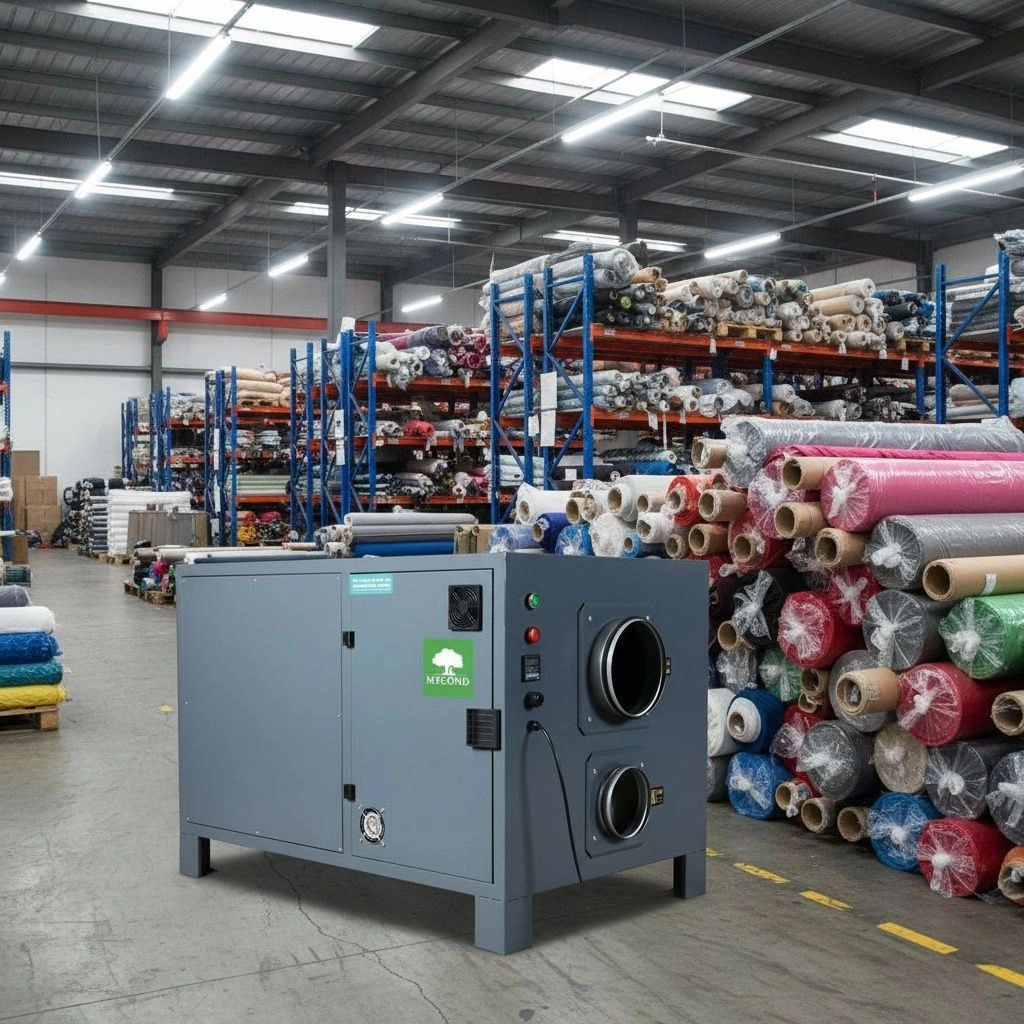
- Cardboard packaging: 45–55% to retain 80% of strength
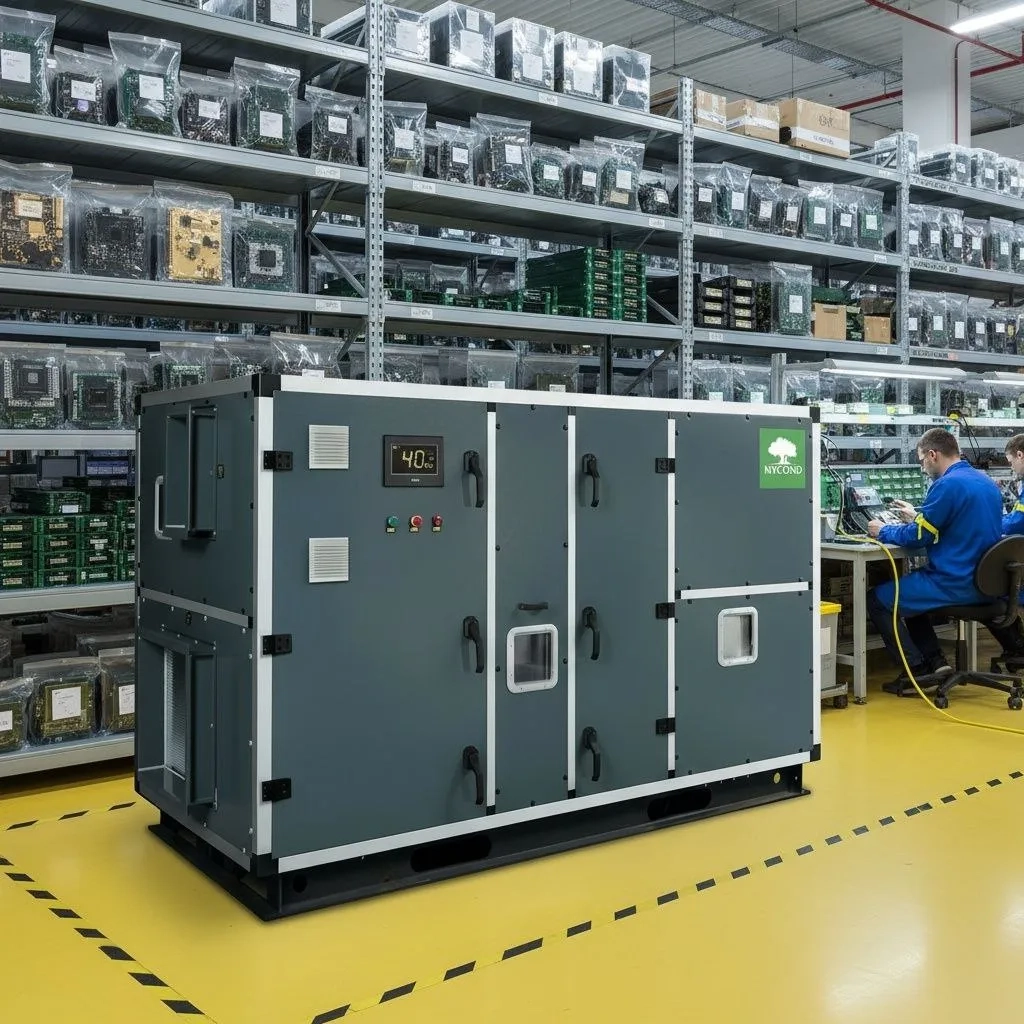
- Electronics and printed circuit boards: 30–45%
- Pharmaceutical warehouses: 30–40% depending on the product
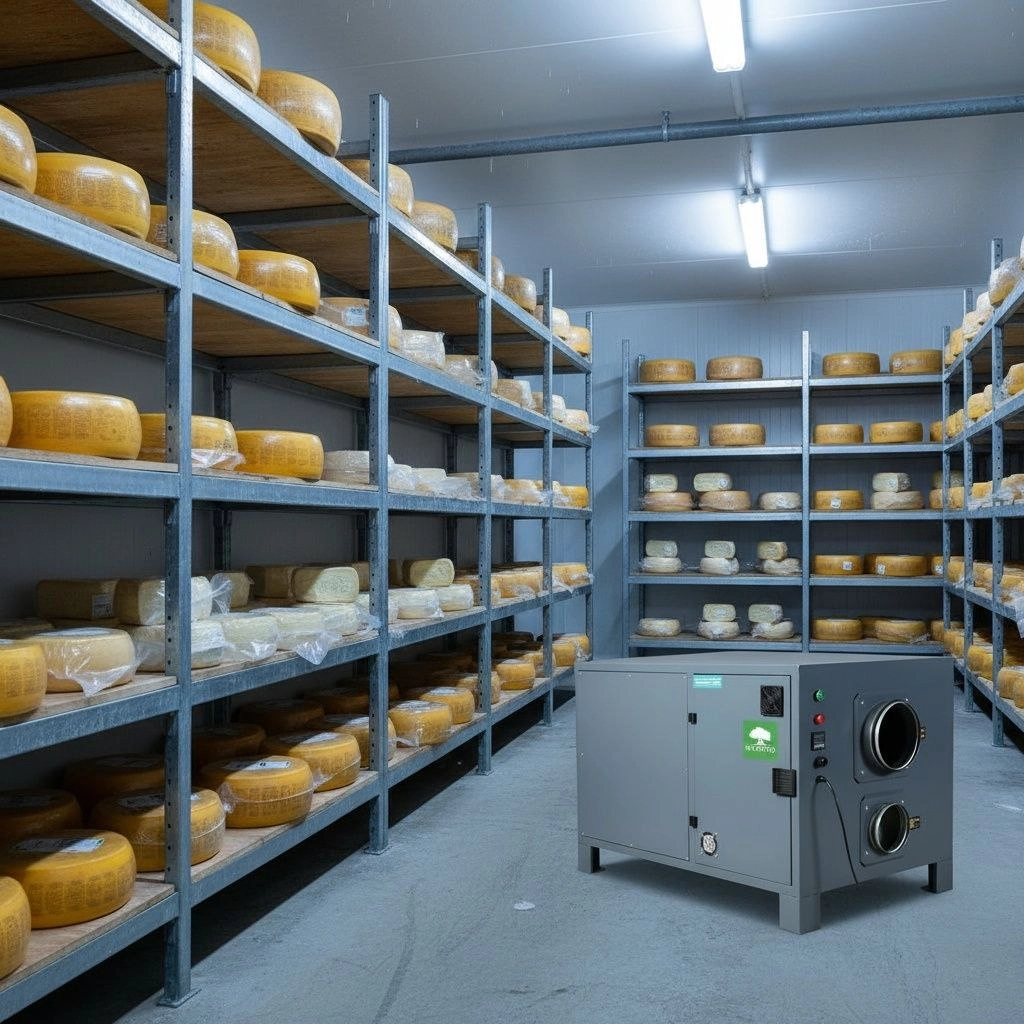
For cold stores, control is based on dew point rather than relative humidity. The air dew point should be 2–3°C below the temperature of the coldest surface. An infrared thermometer is used to determine this surface temperature, and the required dew point is then calculated.
Comparing passive and active warehouses
Passive warehouses (archival repositories, museum collections, long-term storage of military equipment) are characterised by low moisture loads. The main moisture source is vapour diffusion through the envelope and minimal infiltration through leakage. For such spaces, the dehumidification system can be compact with low capacity.
Active warehouses (distribution centres, logistics hubs, production buffers, cold stores) are characterised by high dynamic loads due to frequent door openings, movement of forklifts, personnel presence and incoming moist goods. For example, a 3,000 m³ warehouse with one door opening per hour requires a dehumidifier capacity of about 2–3 kg/h. The same warehouse with 20 openings per hour will require 15–25 kg/h — a difference of 8–10 times for the same room size!
Calculating moisture loads
To design a dehumidification system correctly, all moisture sources and their impact on the warehouse’s total moisture load must be considered:
Door openings — the main moisture source (60–80% of the total load in active warehouses). For example, for a door 4×3.5 m under outdoor conditions of 28°C/75% RH (humidity ratio ~18 g/kg) and indoor conditions of 18°C/45% RH (humidity ratio ~6 g/kg), with an airflow velocity of 0.8 m/s and an opening time of 2 minutes, one opening brings in 1.2–1.5 kg of moisture. At 15 openings per hour this amounts to 18–22 kg/h.
Infiltration through gaps and leakage accounts for 10–25% of the load depending on building condition and pressure differentials.
Vapour permeability through walls, floor and roof accounts for less than 5% of the total load. It is important to note that many designers overestimate this factor and spend significant amounts on additional vapour barriers, whereas even doubling the wall vapour permeability increases the total load by only 3–4%.
Load from personnel is 40–100 g/h per person depending on work intensity.
Moisture release from goods depends on their hygroscopicity. Cardboard, timber and textiles release moisture when the room’s relative humidity is reduced and absorb it when it rises.
Selecting the dehumidification system type
The choice of industrial air dehumidifier for a warehouse depends on operating conditions and humidity requirements:
Condensing dehumidifiers are optimal at air temperatures above 15°C and a target dew point above 7–10°C. Their coefficient of performance (COP) is 2.0–4.0, which makes them economical under high moisture loads and moderate dryness requirements. The limitation is freezing of condensate on the evaporator at low temperatures, which sharply reduces capacity.
Adsorption dehumidifiers for warehouses are required at air temperatures below 15°C or a target dew point below 5°C. They are indispensable for cold stores, low-temperature chambers and spaces with stringent humidity requirements. It is important to note that an adsorption dehumidifier increases the outlet air temperature by 10–15°C due to the heat of adsorption.
Combined systems combine the advantages of both technologies. For example, pre-cooling the supply air from 32°C and 20 g/kg to 18°C and 12 g/kg can reduce the load on the adsorption dehumidifier by 40%.
Architectural and organisational measures to reduce loads
Often the most cost-effective ways to reduce a warehouse’s moisture load are architectural and organisational measures:
High-speed doors reduce opening time from a typical 120–180 seconds to 20–30 seconds, proportionally reducing moisture infiltration through the doorway.
Air curtains create a barrier between outdoor and indoor air with an effectiveness of 70–85% when correctly selected and installed. Airflow velocity should be 8–12 m/s with a tilt angle of 15–20° outward.
PVC strip curtains are especially important for high openings over 3 metres, where intense convective flow occurs due to the density difference between cold and warm air.
Organisational measures include controlling door opening time. For example, reducing the average opening time from 3 to 1 minute can cut the moisture load by 72% without any capital expenditure.
Common design mistakes
When designing dehumidification systems for warehouses, the following mistakes are often made:
- Excessive focus on sealing the warehouse rather than managing door openings. For example, spending €40,000 on additional vapour barriers and wall sealing reduced the load by only 6%, whereas installing high-speed doors for €12,000 reduced the load by 45%.
- Sizing to average rather than peak loads, which leads to insufficient system capacity during critical periods.
- Ignoring initial drying, when new buildings and freshly delivered goods can release moisture for weeks.
- Controlling relative humidity without considering surface temperatures, where a nominal 40% RH does not prevent condensation on cold structural elements.
Conclusions
Successful design of a dehumidification system for a warehouse is based on three key principles:
- Define the real project objective (preventing corrosion, maintaining packaging strength, preventing condensation), not just formal humidity figures.
- Calculate moisture loads with the right priorities, where moisture infiltration through doors has a greater impact than vapour diffusion through walls.
- Select the dehumidification system for the specific temperature conditions and required dew point.
Organisational and architectural measures are often more effective than expensive equipment. A phased approach is recommended: first implement organisational measures, evaluate their effect, and then select equipment for the real, rather than theoretical, load. This approach will ensure optimal relative humidity for storing goods with minimal capital and operating costs.


