









































Author: Mycond Technical Department
Temperature is a critical parameter that determines the efficiency of any air dehumidification system. While many engineers focus primarily on humidity indicators, temperature often becomes the decisive factor influencing performance, energy consumption, and the reliability of equipment operation.
The engineering rationale for this article lies in a systematic error by designers who select the type of dehumidification system exclusively based on humidity parameters, ignoring temperature limitations. This leads to refrigeration system failures in winter, energy overspend due to non-optimal regeneration temperatures, and neglect of air temperature rise after the adsorption process.
Incorrect consideration of temperature dependencies can lead to significant economic losses: an increase in capital expenditure by 15–30% due to selecting excessive equipment capacity (Category B – a typical engineering estimate that may vary depending on the specific project) and higher operating costs due to reduced system energy efficiency.
Theoretical foundations of temperature dependencies
The thermodynamics of moist air is based on the interaction between dry air and water vapour. A key concept for understanding dehumidification processes is the partial pressure of water vapour, which directly depends on temperature according to the Clausius–Clapeyron equation:
ln(p₂/p₁) = (ΔHvap/R) × (1/T₁ - 1/T₂)
where p₁ and p₂ are the vapour pressures at temperatures T₁ and T₂, ΔHvap is the latent heat of vaporisation of water, and R is the universal gas constant.
An important regularity follows from this equation: as temperature increases, the saturated vapour pressure rises exponentially. This is a fundamental principle that governs moisture behaviour in both refrigeration and adsorption dehumidification systems.
The psychrometric chart is a graphical representation of the thermodynamic properties of moist air. On this chart, lines of constant temperature (isotherms) show how air properties change at different values of moisture content and enthalpy. Using a psychrometric chart allows you to visualise all dehumidification processes and predict changes in the air state.
Temperature and refrigeration dehumidifiers
The operating principle of condensation (refrigeration) dehumidifiers is based on cooling the air below the dew point, which leads to moisture condensation. The temperature of the evaporator in the refrigeration system is a key parameter determining the performance of such a dehumidifier.
Refrigeration dehumidifiers have a significant temperature limitation: they lose effectiveness at low air temperatures. When the evaporator temperature drops below 0°C, frost and ice begin to form on its surface, which worsens heat transfer and reduces system performance. To prevent icing, defrost cycles are required, which reduce overall efficiency.
The coefficient of performance (COP) of a refrigeration system is defined as the ratio of useful cooling to the electrical energy consumed. The COP of refrigeration dehumidifiers depends significantly on temperature: the higher the evaporator temperature, the higher the system COP (assuming a constant condenser temperature). This is explained by a reduction in the pressure difference within the refrigeration circuit.
Seasonal fluctuations in the performance of refrigeration dehumidifiers can be significant. As ambient temperature decreases, cooling capacity increases, but due to the risk of evaporator icing, the overall moisture removal efficiency may fall. Therefore, modern systems use temperature compensation in control algorithms.
Adsorption desiccant dehumidifiers
Unlike refrigeration systems, adsorption dehumidifiers exhibit the opposite temperature dependence of efficiency: the lower the temperature of the process air, the higher the moisture removal efficiency. This is explained by the lower surface vapour pressure of the cold desiccant, which creates a larger gradient for moisture transfer from the air.
The key advantage of adsorption systems appears at low temperatures, when refrigeration systems no longer operate effectively. Desiccant dehumidifiers maintain high performance even at sub-zero temperatures, making them indispensable for cold stores and unheated premises in winter.
It is important to note that the process of moisture adsorption leads to an increase in the temperature of the process air due to the release of the heat of adsorption. This temperature rise is directly proportional to the amount of moisture removed. In some cases, post-cooling of the air may be required if the increased temperature does not meet the requirements of the technological process.
A critical parameter for adsorption systems is the desiccant regeneration temperature. Effective removal of moisture from the desiccant requires a high temperature. Different types of adsorbents have different optimal regeneration temperatures:
- Silica gel – typically regenerated at 120–180°C (Category B – a typical engineering range that depends on the specific type of silica gel and the manufacturer)
- Molecular sieves – require higher regeneration temperatures, often 200–300°C (Category B – the range depends on the type of molecular sieve)
- Lithium chloride – regenerated at lower temperatures, around 80–120°C (Category B – the range depends on concentration and carrier)
It is important to note that the temperature ranges given are typical engineering guidelines (Category B), and specific design values should be determined according to the equipment manufacturer’s documentation for the specific type of desiccant.
Temperature performance curves and system selection algorithms
Temperature performance curves are graphs showing how the efficiency of a dehumidifier changes depending on temperature with other parameters fixed (humidity, air velocity). They are an indispensable tool for the proper design of dehumidification systems.
To select the optimal dehumidification system, the following algorithm can be used, which takes account of temperature characteristics:
- Determine the range of process air operating temperatures throughout the year.
- If the process air temperature can drop below the critical value for the refrigeration system (as specified by the equipment manufacturer), then a refrigeration system is unsuitable and an adsorption system is required.
- If the temperature always remains within the operating range of the refrigeration system, it will usually be optimal in terms of energy efficiency.
- If a very low dew point is required that cannot be achieved by refrigeration systems, an adsorption dehumidifier should be selected regardless of the temperature range.
- For high-temperature applications, consider pre-cooling before dehumidification.
It is important to note that this algorithm does not contain fixed numerical thresholds, as specific values depend on the type of equipment, manufacturer, and project specifics.
Seasonal temperature variation and design
The annual temperature profile significantly affects the operation of dehumidification systems. In the United Kingdom, especially in cities such as London, Birmingham, Manchester, Glasgow, Liverpool, and Edinburgh, seasonal temperature fluctuations can be significant.
For refrigeration dehumidifiers, winter operation involves additional challenges due to low temperatures. To ensure stable operation, power modulation and special anti-icing protection systems may be required.
Adsorption systems in cold climates require adjustments to regeneration heater capacity. In winter, the inlet regeneration air is colder, so more energy is needed to achieve the required regeneration temperature.
Designing with the entire annual temperature profile in mind allows energy consumption to be optimised and ensures reliable system operation under any conditions.
Thermal integration of systems and energy efficiency
Multi-stage desiccant regeneration can significantly improve the energy efficiency of adsorption systems. Instead of heating the entire regeneration air stream to the maximum temperature, a staged approach with preheating and heat recovery can be used.
Using waste heat for desiccant regeneration is an effective way to reduce operating costs. Heat sources may include:
- Condenser heat from refrigeration machines
- Heat from technological processes
- Combined heat and power (CHP) units
- Low-temperature renewable energy sources
Pre-cooling the air before an adsorption dehumidifier is advisable at high ambient temperatures. By reducing the air temperature before it enters the adsorption system, its efficiency can be increased and the service life of the desiccant extended.
Temperature design strategies for different applications
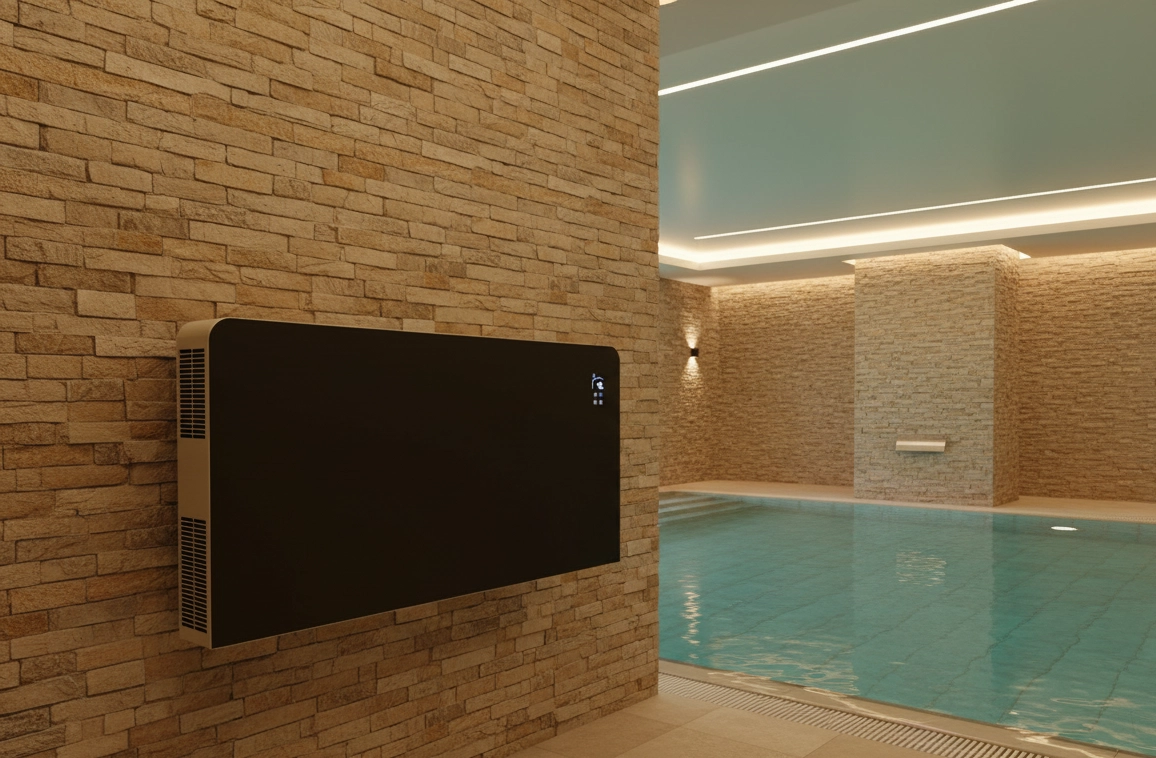
For swimming pools, it is important to consider the high air temperature and humidity. Pool dehumidifiers should operate efficiently at 28–32°C (Category B – a typical range that depends on the type of pool). Refrigeration dehumidifiers are often combined with heat pumps for heat recovery.
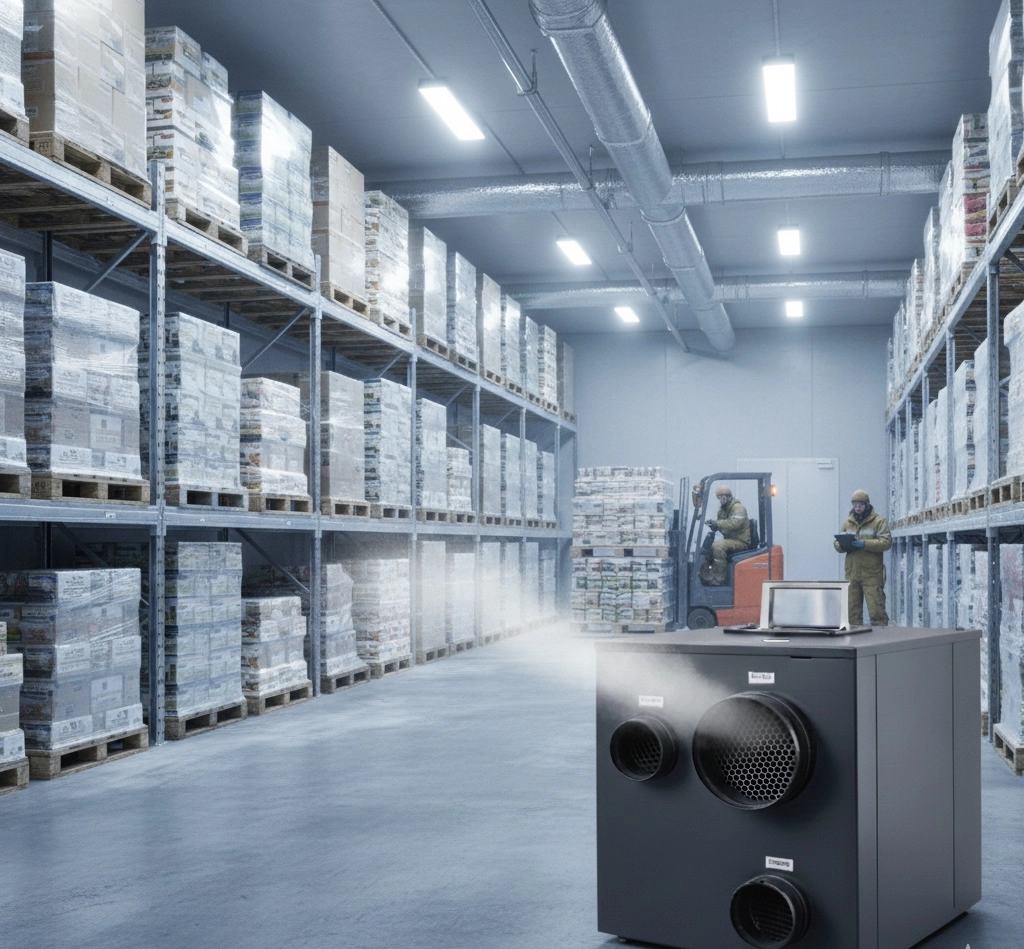
Warehouses and logistics centres are characterised by a wide temperature range. In unheated warehouses in the United Kingdom, winter temperatures can drop to values critical for refrigeration dehumidifiers, so adsorption systems are preferred in such cases.
In pharmaceutical production, it is crucial to maintain stable conditions with minimal temperature and humidity deviations. Dehumidification systems are often integrated with precision climate control equipment.
Common design mistakes
The most common temperature-related mistakes when designing dehumidification systems are:
- Underestimating seasonal fluctuations – designing only for summer peaks leads to insufficient capacity in winter or system inoperability at low temperatures.
- Incorrect choice of regeneration temperature – too low a temperature does not provide effective desiccant regeneration, while too high a temperature can damage the material.
- Ignoring dew-point temperature – leads to condensation, equipment corrosion, and microbiological issues.
- Failure to account for temperature rise after adsorption – may lead to overheating of the space or incompatibility with process requirements.
To avoid these mistakes, a detailed analysis of temperature regimes must be carried out at the design stage, taking into account all seasonal changes and the specifics of the facility.
Conditions where standard approaches are unsuitable
There are situations where standard approaches to designing dehumidification systems need to be adjusted:
- Boundary temperature regimes with extremely low or high temperatures
- Modes with rapid temperature fluctuations, where system inertia becomes critical
- Facilities with special requirements (museums, laboratories, clean rooms)
- Regions with extreme climates, where the annual temperature range is very large
In such cases, an individual approach is required, taking the specifics of the facility into account and possibly using combined systems or special technical solutions.
Frequently Asked Questions (FAQ)
Why do refrigeration dehumidifiers not work at low temperatures?
Refrigeration dehumidifiers lose effectiveness at low temperatures for several reasons. The main issue is evaporator icing when its temperature drops below 0°C. The formation of frost and ice worsens heat transfer and reduces performance. In addition, at low temperatures the absolute humidity of the air is already low, so the potential for dehumidification decreases. The temperature threshold of effectiveness depends on the specific model and equipment manufacturer.
What is the optimal regeneration temperature for silica gel?
The optimal regeneration temperature for silica gel is usually in the range of 120–180°C (Category B – a typical engineering range). However, the specific value depends on the type of silica gel, the required depth of drying, and the system’s energy constraints. At lower regeneration temperatures, the effectiveness of restoring adsorption properties decreases, but energy consumption is lower. The optimal value should be determined according to the manufacturer’s documentation for the specific type of silica gel.
How to calculate the effect of temperature on the COP of a refrigeration dehumidifier?
The calculation of the dependence of COP on temperature is based on the thermodynamic principles of the refrigeration cycle. For a qualitative estimate: increasing the evaporator temperature by each 1°C usually leads to a 2–4% increase in COP (Category B – a typical engineering estimate). An exact calculation requires knowledge of the characteristics of the specific refrigerant, compressor parameters, and heat exchangers. For design decisions, equipment manufacturer data should be used, usually provided as performance tables or graphs.
When is it appropriate to use pre-cooling before an adsorption dehumidifier?
Pre-cooling before an adsorption dehumidifier is advisable in the following cases: 1) at high inlet air temperatures (above 35°C, Category B); 2) when maximum adsorption system performance is required; 3) to extend the desiccant service life; 4) when a low-cost source of cooling is available. The economic feasibility of pre-cooling must be evaluated individually for each project, comparing additional capital costs with increased efficiency and reduced operating costs.
How does the temperature rise after adsorption affect the overall air-conditioning system?
The temperature rise after adsorption dehumidification can significantly affect the air-conditioning system. Due to the heat of adsorption, the air temperature can increase by 5–15°C (Category B – a typical range) depending on the amount of moisture removed. This increase must be considered when calculating the cooling capacity of the air-conditioning system. In some cases, additional cooling after dehumidification is required, which increases overall energy consumption. However, in winter this heat can be beneficial, reducing the need for space heating.
Conclusions
Temperature is a critically important parameter that determines the efficiency of air dehumidification systems. To ensure optimal operation, temperature dependencies must be considered at all stages of design and operation:
- Refrigeration (condensation) dehumidifiers are most effective at moderate temperatures and lose performance at low temperatures.
- Adsorption desiccant dehumidifiers are effective over a wide temperature range, including low temperatures, but require high-temperature regeneration.
- Design should consider the entire annual temperature profile of the facility, not just extreme conditions.
- Thermal integration of systems and the use of waste heat can significantly increase energy efficiency.
- For each specific application, there is an optimal dehumidification strategy that takes into account the temperature characteristics of the facility.
Proper consideration of temperature dependencies helps avoid common design mistakes, ensures reliable system operation in all modes, and optimises both capital and operating costs.


