









































Author: Mycond Technical Department
Introduction: the consequences of incomplete accounting of moisture sources
Underestimating moisture loads when designing dehumidification and air conditioning systems is one of the most common engineering mistakes, leading to serious technical and economic consequences. A typical design error is to account for only 1–2 of the most obvious moisture sources (for example, only people in public buildings or only open water surfaces in swimming pools) while ignoring the rest.
The consequences of incomplete accounting of indoor moisture sources are catastrophic: condensation on cold surfaces, corrosion of metal structures and equipment, mould and fungal growth, excessive energy consumption by cooling systems, emergency wear of equipment and deterioration of air quality. In the United Kingdom, with its humid climate, especially in coastal cities such as Liverpool or Glasgow, this problem is particularly acute.
In this article, we examine in detail seven main sources of moisture loads in buildings and the methods for calculating them, enabling engineers and designers of ventilation and dehumidification systems to avoid typical mistakes.
Physical fundamentals of water vapour mass transfer
To understand moisture transfer processes in buildings, it is necessary to work with basic psychrometric parameters. Key among these are the humidity ratio (g/kg), which determines the mass of water vapour per kilogram of dry air; relative humidity (%), which shows the ratio of the partial pressure of water vapour to the saturation pressure at a given temperature; and the dew-point temperature – the temperature at which the air reaches saturation and condensation begins.
The driving forces of water vapour mass transfer in buildings are:
- Humidity ratio difference – moisture naturally moves from areas with higher humidity ratio to areas with lower
- Temperature gradient – water vapour moves from warmer zones to cooler ones
- Air velocity – increasing air speed intensifies moisture transfer
The intensity of water vapour mass transfer depends on the difference in partial pressures, temperature (a higher temperature accelerates evaporation and diffusion), and the air velocity over a moist surface. These physical laws underpin the calculation of all moisture sources in buildings.
Source 1: Infiltration of humid air through the building envelope
The mechanism of humid air infiltration involves the ingress of outdoor air into the premises through leaks in the building envelope: gaps in window and door openings, poor panel joints, cracks in walls, and unsealed service penetrations. This problem is particularly critical for older UK buildings, where envelope airtightness often falls short of modern standards.
The methodology for calculating moisture loads from infiltration is based on the formula: mass flow rate of infiltration air (kg/h) multiplied by the difference in humidity ratio between outdoor and indoor air (g/kg). The intensity of infiltration depends on:
- Wind pressure (especially critical for high-rise buildings)
- Temperature difference between outdoor and indoor air (creates stack effect)
- Building airtightness class (from A – high airtightness to E – low)
It is important to consider seasonal variability: in the UK’s humid climate, the outdoor humidity ratio in summer often exceeds the indoor level, and infiltration can account for 40–60% of total indoor moisture loads, especially in coastal areas such as Liverpool or Edinburgh.
Source 2: Moisture emissions from people (breathing, perspiration)
The human body is a constant source of water vapour through breathing and perspiration. Exhaled air is saturated with water vapour at about 37°C. Perspiration intensity depends significantly on physical activity, indoor temperature, and clothing type.
Standard values for moisture emission per person vary depending on conditions:
- At rest at 20–22°C: 40–50 g/h
- Light physical work: 70–120 g/h
- Intense physical activity: 150–300 g/h
The method for calculating moisture emissions from people involves multiplying the number of occupants by the specific moisture emission corresponding to activity and temperature conditions. For different types of premises in the UK, the following indicative values can be used: offices – 50–70 g/h per person, gyms – 150–250 g/h per person, retail spaces – 60–80 g/h per person.
It is important to account for actual occupancy and the intermittency of presence, especially in public buildings in London or Manchester with high footfall.
Source 3: Open doors, gates, loading docks
Opening doors, gates and loading docks leads to intensive moisture exchange with the outdoor environment via two mass transfer mechanisms:
- Natural convection due to density differences between warm indoor and cooler outdoor air
- Forced air exchange due to the movement of people, vehicles, and goods through the opening
The method for estimating moisture loads through open openings is calculated by the formula: volume of air entering per opening event (m³) × difference in humidity ratio (g/kg) × opening frequency (times/h).
For warehouse doors with an area of 10–20 m² and an opening duration of 2–5 minutes, up to 500–2000 m³ of air may enter per opening. In the UK’s humid climate, this source can be critical, especially for logistics centres in Birmingham or Manchester with high-intensity loading operations.
Calculation algorithm:
- Determine the opening area
- Estimate the opening frequency and duration
- Calculate the mass of moisture entering per hour
Source 4: Moist products and materials
Moisture release from products and materials is the process of evaporation from:
- Food products (vegetables, fruit, meat, fish)
- Building materials (fresh concrete, plaster)
- Textiles, paper, timber and other hygroscopic materials
Methods for assessing product moisture release can be carried out in three ways:
- By measuring changes in product mass during storage
- Using empirical moisture release coefficients
- Via drying kinetics
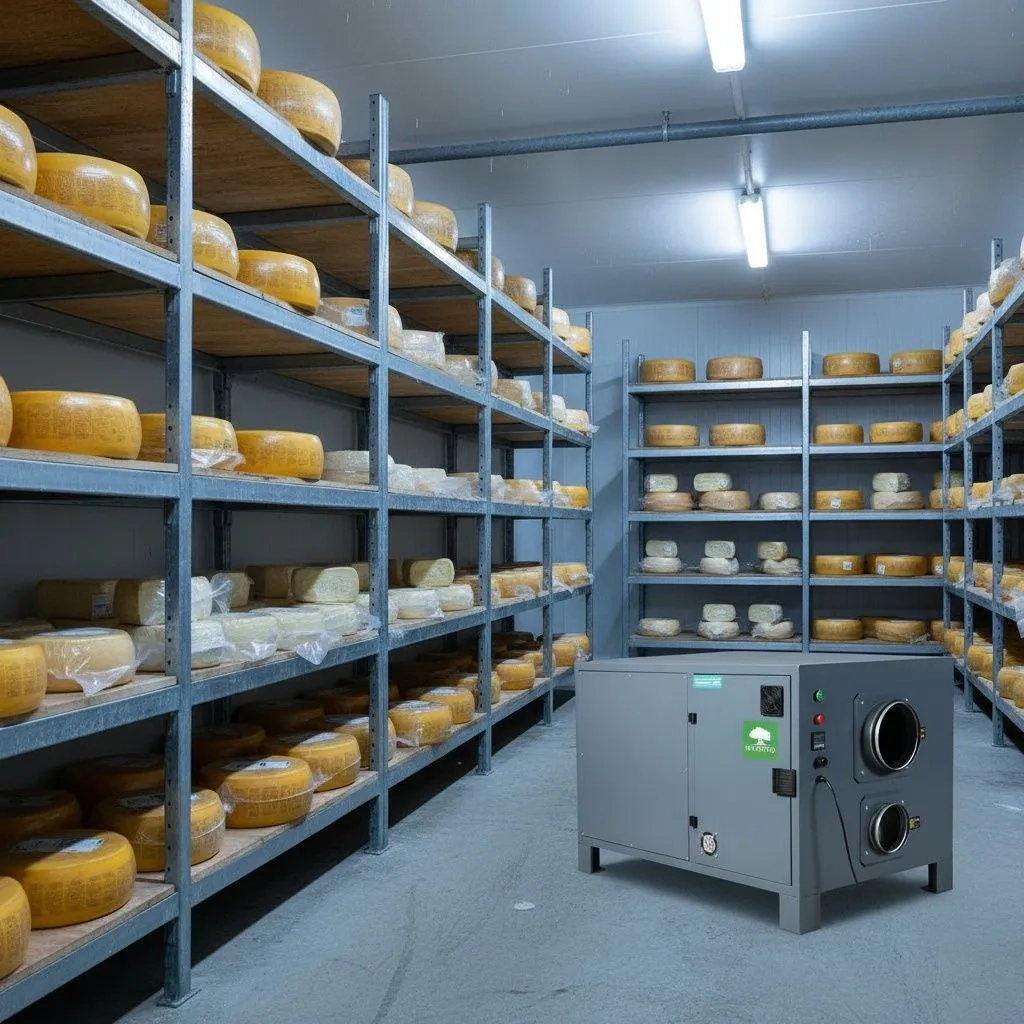
The intensity of moisture release depends significantly on storage temperature, air velocity over the product surface, and the initial moisture content of the material. For example, fresh fruit at 20°C can release up to 10–15 g of moisture per kg of product per day, while fresh concrete can release up to 80–100 g/m² per day during the first days of curing.
For the UK market, where warehouse and cold storage complexes are concentrated around major cities (Birmingham, Manchester, London), accurate calculation of product moisture release is especially important for designing efficient ventilation systems.
Source 5: Open water surfaces (pools, tanks)
Evaporation from open water surfaces is based on the physics of water vapour mass transfer from the water surface to the air. This process is intensified by higher water temperature, lower air relative humidity, and increased air velocity over the water surface.
To calculate evaporation intensity, empirical formulas are used that account for the difference between the saturation vapour pressure at the water temperature and the partial pressure of water vapour in the air, as well as coefficients dependent on air velocity.
Calculation algorithm for moisture emissions from water surfaces:
- Determine the water surface area (m²)
- Measure water and air temperatures
- Calculate the difference in saturation vapour pressures
- Apply the evaporation formula: G(moisture) = area × evaporation coefficient × pressure difference
It is especially important to calculate moisture release accurately for swimming pools, where water temperature is usually maintained between 26–30°C. For a typical pool with an area of 100 m² at 28°C water temperature and 60% air relative humidity, moisture release can be 7–10 kg/h.
Sources 6 and 7: Supply ventilation and technological processes
Moisture from ventilation arises when outdoor air supplied by the supply ventilation system is not properly dehumidified. In the climatic conditions of the UK, especially in coastal cities, outdoor air often has a high humidity ratio, leading to significant moisture loads.
Moisture loads from supply ventilation are calculated using the formula: mass flow rate of supply air (kg/h) × (humidity ratio of outdoor air − humidity ratio of indoor air) (g/kg).
Technological moisture sources cover a wide range of industrial processes:
- Equipment and room washing
- Industrial laundry and drying
- Boiling, steaming, sterilisation
- Hot pressing, extrusion, casting processes
The methodology for inventorying technological moisture sources includes:
- Compiling a complete list of moisture-emitting processes
- Assessing water/steam consumption for each process
- Converting to water vapour mass per hour with regard to equipment operating schedules
For manufacturing facilities in the industrial zones of Manchester, Birmingham or Glasgow, accurate assessment of technological moisture emissions is critically important to ensure the required microclimate and prevent equipment corrosion.
Total moisture loads: calculation methodology and common design errors
The algorithm for determining total moisture loads includes:
- Inventorying all potential moisture sources for the specific site
- Calculating moisture emissions from each source separately
- Summing all components with consideration of their simultaneity
- Adding a 10–20% allowance for unaccounted factors (depending on uncertainty)
Common design errors leading to underestimation of moisture loads:
- Ignoring infiltration, especially in summer in the UK’s humid climate
- Using outdated standards for moisture emissions from people
- Lack of seasonal correction in calculations
- Applying fixed handbook values without site-specific adjustments
There are conditions under which standard calculation methods can yield significant errors:
- Extreme climatic conditions (relative humidity 90–100%, characteristic of some UK coastal areas)
- Complex technological processes with unstable moisture emissions
- Sites with irregular operating regimes
In such cases, instrumental verification at operating analogous sites or the use of computer modelling methods is required.
FAQ: Frequently asked questions
How to determine the priority of accounting for moisture sources?
Prioritisation depends on the type of site. For public buildings in London or Birmingham, the main sources are usually people and infiltration. For industrial sites – technological processes and ventilation. For swimming pools – water surfaces. An initial Pareto analysis is recommended: identify the 20% of sources that account for 80% of moisture loads.
Can fixed handbook values for moisture loads be used?
Handbook values provide only indicative numbers and always require adjustment to the specific site. This is especially true for UK cities with differing climatic conditions – from relatively dry London to very humid Glasgow. Actual values may deviate from handbook values by 30–50%.
How to account for seasonal changes in moisture loads from infiltration?
Calculations should be performed for each characteristic period of the year using climatological data for the specific UK city. In the humid British summer, infiltration often produces maximum moisture loads, while in winter it may, conversely, lead to drying of indoor air.
What instrumental methods allow measurement of actual moisture loads?
On an operating site you can apply: the mass balance method (measuring the moisture content difference between supply and extract air), the differential method (measuring the change in humidity ratio when switching individual sources on/off), and the method of direct condensate measurement from dehumidification systems.
How to calculate moisture emissions from open doors if the opening frequency is unknown?
In this case, statistical observations are carried out on similar sites, or empirical formulas are used based on the functional purpose of the premises, number of visitors, and operating schedule. For shopping centres in Manchester or London, for example, the average door opening frequency can be 30–60 times per hour during peak periods.
Is a capacity margin above calculated moisture loads required for equipment?
Yes, the recommended capacity margin for dehumidification systems is 15–30%. For sites in the humid climate of UK coastal areas, as well as sites with hard-to-predict moisture loads, the margin is increased to 30–40%.
Which moisture sources are most often ignored by designers?
Most often underestimated are: infiltration through the building envelope (especially in older buildings in Edinburgh or Liverpool), moisture emissions from open doors, moisture from ventilation without proper dehumidification, and moisture release from building materials in new buildings. This leads to insufficient dehumidification capacity, condensation, and mould growth.
Conclusions
Accurate calculation of all moisture sources in buildings is a fundamental basis for designing effective dehumidification and air conditioning systems. The key principles of such calculation are:
- Comprehensive accounting of all seven categories of moisture sources
- Adapting calculations to the specific site and its characteristics
- Considering seasonality and the climatic features of the construction location
Recommendations for system design engineers under UK conditions:
- Carry out a detailed inventory of all potential moisture sources
- Do not rely solely on handbook values
- Consider the specifics of the UK’s humid climate, especially in coastal areas
- Provide a capacity margin for dehumidification systems
- Ensure the ability for instrumental humidity control during operation
The accuracy of moisture load calculations directly determines the reliability, energy efficiency and cost-effectiveness of the entire air conditioning and dehumidification system. Underestimating moisture loads in the UK’s humid climate can lead to serious microclimate problems and damage to structures and equipment, ultimately resulting in significant financial losses for building owners.


