









































Author: Mycond Technical Department
Desiccant cooling is an innovative alternative to traditional vapour-compression air-conditioning systems, enabling effective humidity control. The conventional approach to dehumidification involves cooling air below the dew point followed by reheat, which leads to significant energy losses. The magnitude of these losses is derived from the heat balance and depends on the initial air parameters, the required dehumidification depth, and heat exchanger effectiveness.
The core principle of desiccant cooling is the separation of sensible (temperature) and latent (moisture) load handling. First, the air is dehumidified by adsorbing moisture onto a specialised material (desiccant), and then it is cooled. This approach avoids the energy-intensive overcooling of the air.
Historically, desiccant cooling technology began to develop actively in the 1980s, when compact rotating wheels with adsorptive materials appeared. Economic drivers included energy crises and rising electricity costs, which prompted engineers to seek more efficient air-conditioning solutions.
Physical fundamentals of desiccant dehumidification
Moisture adsorption in desiccant systems is a physico-chemical process based on the diffusion of water vapour driven by the difference in partial pressures between the air and the desiccant surface. A key feature of desiccant materials is their enormous specific surface area, which can range from 200 to 800 m²/g depending on the material type, manufacturing method, and granulation.
After being saturated with moisture, the desiccant requires regeneration, which is carried out by heating to a temperature that depends on the material type and the target dew point. For silica gel, the most common desiccant, regeneration temperature typically ranges from 80–120°C, while for molecular sieves it is 200–350°C. These ranges are indicative and should be confirmed in the manufacturer’s technical documentation.
An important thermodynamic effect during moisture adsorption is the release of sorption heat, comprising the latent heat of condensation and the chemical heat of binding. The total heat release can be 2500–3000 kJ/kg of removed moisture, depending on the type of desiccant, process conditions, moisture concentration, and temperature.
On a psychrometric chart, the desiccant dehumidification process appears as the air state moving downwards along a line of constant humidity ratio (reduction in moisture content), with a simultaneous shift to the right (temperature increase) due to the release of sorption heat. For example, if air at 25°C and 60% relative humidity passes through a desiccant wheel, its relative humidity may drop to 20–30%, while its temperature may rise to 35–40°C.
The coefficient of residual heat in desiccant systems is a function of many variables and typically ranges from 0.7 to 0.85. The specific value depends on the wheel design, rotation speed, and recovery effectiveness.
Components of a desiccant system
The central element of a desiccant system is the rotating wheel coated with an adsorptive material. The percentage of desiccant coverage depends on the manufacturer and the system’s purpose and may constitute 70–90% of the wheel area. The wheel diameter is determined by airflow and is calculated from the air velocity through the cross-section, typically 2.5–3.5 m/s. Wheel depth varies from 100 to 400 mm, and rotation speed from 10 to 30 revolutions per hour.
The regeneration system includes a heater for the regeneration air, the temperature of which is determined by the desiccant type and the required regeneration depth. Regeneration airflow usually accounts for 20–40% of the process air volume, although this ratio depends on regeneration temperature, outdoor air parameters, and target dew point. Energy consumption for regeneration is 3000–4500 kJ/kg of removed moisture, depending on recovery effectiveness and heat exchanger losses.
An enthalpy heat-exchange wheel is used for energy recovery between air streams. The effectiveness of such a heat exchanger typically ranges from 65–85% and depends on the design, rotation speed, and counterflow arrangement.
An indirect evaporative cooling system makes it possible to efficiently reduce the temperature of the dehumidified air. The effectiveness of this system is 60–90% and strongly depends on outdoor humidity, heat exchanger design, air velocity, and water spray quality.
Absorption chillers: operating principle and integration
An absorption chiller is a thermal refrigeration machine that uses water as the refrigerant and lithium bromide (LiBr) as the absorbent. Its operating cycle comprises four main components:
1. Evaporator – where water evaporates at low pressure (0.6–1.2 kPa) and low temperature (3–10°C), extracting heat from the chilled water or air.
2. Absorber – where water vapour is absorbed by a concentrated LiBr solution. This process releases heat that must be removed by cooling the absorber.
3. Generator – where the solution is heated to a temperature that depends on the machine type. For single-effect machines this is usually 80–110°C, and for double-effect machines 140–180°C.
4. Condenser – where the vapour condenses, rejecting heat to the cooling water.
The coefficient of performance (COP) of absorption chillers for single-effect machines usually ranges from 0.6 to 0.8, and for double-effect machines from 1.0 to 1.3. These values are lower than those of vapour-compression chillers (COP 3.0–5.5), but absorption chillers use inexpensive thermal energy instead of costly electricity, changing the economic assessment.
Sources of thermal energy for absorption chillers and desiccant systems can be ranked in order of increasing cost:
- Waste heat – from various industrial processes, CHP, cogeneration units (temperature 70–180°C).
- Solar energy – via collectors reaching 70–120°C depending on type and insolation conditions.
- Natural gas – at tariffs that vary by region and season. The efficiency of modern burners is 85–95%.
- Electric heaters – the most expensive source with around 100% efficiency but high energy cost.
There are three main schemes for integrating desiccant dehumidification with absorption chillers:
1. Series treatment – air passes through the desiccant wheel, where moisture is removed and temperature rises, and is then cooled by the absorption chiller. Advantage: independent control of temperature and humidity.
2. Parallel treatment – the desiccant treats fresh outdoor air, and the absorption chiller cools recirculated air. Advantage: reduced overall load on the chiller.
3. Cogeneration scheme – a single heat source supplies both desiccant regeneration and the chiller generator. Advantage: maximum utilisation of the primary fuel energy.
Synergistic effects of combining technologies
Integrating desiccant cooling with absorption chillers creates several important synergistic effects:
1. Both systems consume thermal energy, allowing load shifting away from the peak electrical grid and reducing capacity charges.
2. Pre-dehumidification with a desiccant lowers the air dew point, allowing the chilled water temperature from the chiller to be raised from the traditional 6–7°C to 12–15°C. This increase in evaporator temperature improves the chiller COP. Indicatively, for every 5–7°C increase in evaporator temperature, COP can improve by 0.05–0.15 (depending on the specific machine characteristics).
3. The possibility of using low-grade waste heat (60–80°C) for regenerating low-temperature desiccants, which is particularly relevant for facilities with available heat rejection.

Energy efficiency and performance metrics
The coefficient of performance (COP) for desiccant cooling systems is defined as the ratio of useful cooling capacity to the sum of all energy inputs. Typical COP values, depending on system configuration, can vary from 0.5 to 1.8.
For a basic scheme, COP is determined by the balance of thermal and electrical energy used. In a heat-recovery scheme, COP increases due to savings on regeneration. In a fully thermal scheme, the overall COP accounts for integrated energy use and can reach 1.3–1.6, depending on the efficiency of the cogeneration unit.
Compared with traditional cool-and-reheat dehumidification systems, desiccant systems have advantages in three main cases:
- High proportion of latent load (sensible heat ratio (SHR) below 0.7–0.75).
- Requirement for a low dew point (below 10–12°C), where condensation-based systems become inefficient.
- Availability of inexpensive thermal energy, making thermal regeneration economically feasible.
Two-stage regeneration is an effective method of increasing energy efficiency. The first stage uses lower-temperature heat (60–80°C) to remove part of the moisture, and the second stage uses higher-temperature heat (80–120°C) to remove the remainder. This saves 20–40% of high-temperature energy, depending on stage split and process effectiveness.
The concept of energy storage in desiccant systems enables regeneration during off-peak tariffs. The economic effect depends on the tariff structure, storage volume, and capital costs for additional tanks.
Typical applications of desiccant systems
Supermarkets are among the most suitable facilities for desiccant cooling, as open display cases create significant latent loads. A desiccant system maintains humidity at 40–50%, which is optimal for product preservation. An additional advantage is the possibility of using rejected heat from refrigeration condensers for desiccant regeneration.
In hotels, where fresh air constitutes a significant share of overall air exchange and carries the main latent load, desiccant systems allow the chiller size to be reduced by 20–40%, depending on the load structure. This also reduces peak electrical consumption, which is critical for hotels where the morning peak often coincides with the highest tariff period.
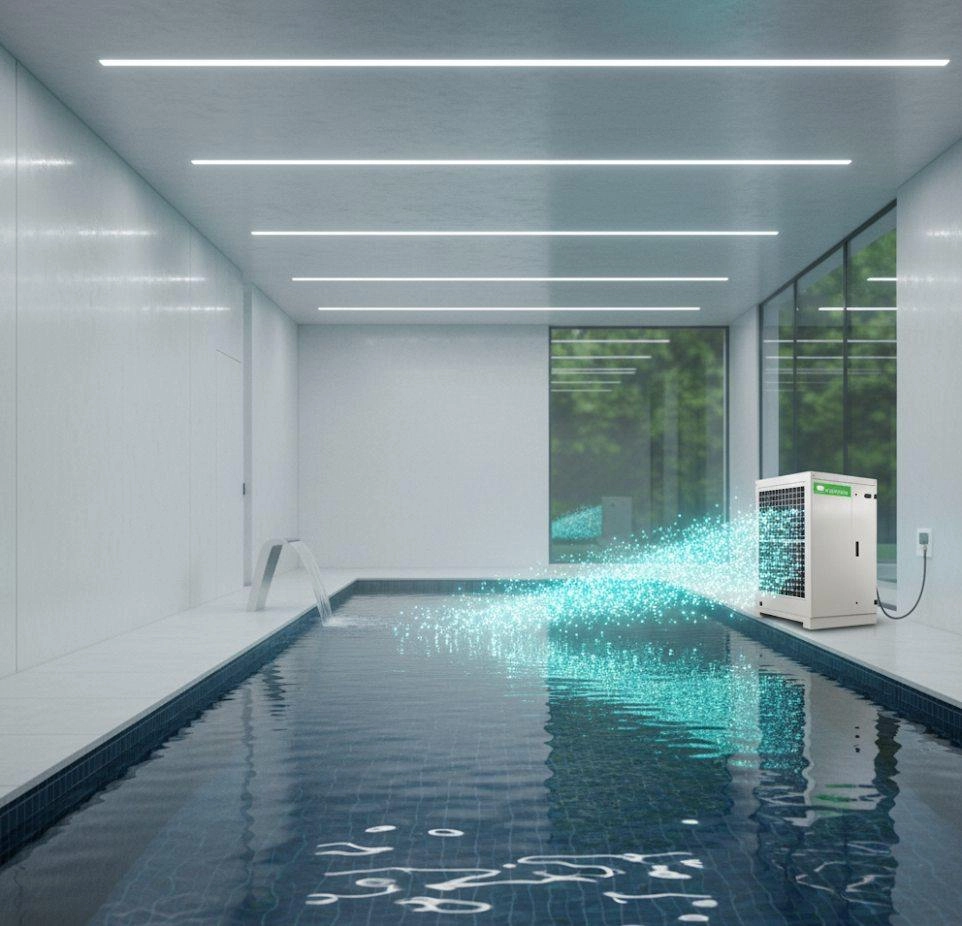
Swimming pools are characterised by high latent loads due to evaporation from the water surface. The sensible heat ratio for pools usually ranges from 0.3–0.5, which is ideal for desiccant systems.
Radiant cooling systems require the air dew point to be 2–3°C below the temperature of cooled surfaces to prevent condensation. Desiccant systems reliably maintain a low dew point even at peak loads.
Integration with variable air volume (VAV) systems and building management systems (BMS) allows the implementation of sophisticated algorithms for modulating desiccant system capacity according to the actual load.
Design solutions and optimisation
Calculating airflow rates is a critical aspect of designing desiccant systems. Process airflow is determined from the moisture balance as the ratio of moisture generation to the difference in humidity ratio. To achieve the target dew point under given conditions, the air must be dehumidified by a certain amount, which dictates the required airflow.
Regeneration airflow is determined by the required depth of moisture desorption from the desiccant. The process-to-regeneration air ratio usually varies from 2:1 to 4:1, depending on regeneration temperature and outdoor air parameters.
The choice of regeneration temperature depends on the desiccant type and the target dew point. The general rule is: increasing regeneration temperature improves dehumidification depth but increases energy consumption. The optimum is determined by a techno-economic analysis.
Several options are possible for energy recovery between air streams:
- Rotary wheel – high effectiveness (65–85%), but slight moisture carry-over between streams can occur.
- Plate recuperator – lower effectiveness (50–70%), but complete absence of moisture transfer.
- Heat pump – COP 3.0–5.0, may be more economical under certain conditions.
Minimising air leakage between the process and regeneration zones is important. Even small leaks (3–5% of the process flow) can significantly degrade system performance. To assess the impact of leakage: leakage of high-humidity air into a low-humidity stream increases outlet humidity in proportion to the flow ratio and the difference in humidity ratios.
Desiccant system capacity control can be implemented via:
- Basic control – simple on/off regeneration, but inefficient due to the wheel’s thermal inertia.
- Proportional control – smooth regulation of regeneration temperature or wheel rotation speed.
- Predictive control – uses a system model and load forecast to optimise operation.
Economic aspects
Capital costs for desiccant systems with absorption chillers are usually higher than for traditional air-conditioning systems. However, these additional costs are partially offset by a reduction in chiller size and savings on electrical connections.
The operating cost structure for a desiccant system includes thermal energy for regeneration (the main part) and electricity for fans. For a traditional system, costs are primarily electricity for the compressor and reheat. The comparison depends on the ratio of electricity to heat tariffs.
Key factors determining the economic feasibility of desiccant systems:
- The ratio of electricity to gas/heat tariffs.
- Climate zone (systems are more effective in hot and humid climates).
- Operating regime (a long cooling season favours quicker payback).
- Availability of low-cost thermal energy (especially waste heat).
The payback period calculation is based on the difference in annual operating costs (traditional system minus desiccant system) divided by the additional capital investment. The method accounts for all factors, including tariff structure, operating hours, and latent load.
The impact on peak electrical demand is substantial, especially under tariffs with capacity charges. Desiccant systems reduce peak demand by shifting load from electrical to thermal energy, which can significantly shorten the payback period.
Frequently asked questions
How is desiccant cooling fundamentally different from traditional air-conditioning, and when is it appropriate?
Traditional air-conditioning uses a single process to reduce temperature and humidity simultaneously by cooling air below the dew point followed by reheat. This requires substantial energy, the magnitude of which depends on air parameters and dehumidification depth.
Desiccant cooling separates humidity and temperature control, enabling independent adjustment of these parameters. The appropriateness of its application is determined by three main factors:
- High proportion of latent load (over 30–40% of the total)
- Requirement for low humidity (dew point below 10–12°C)
- Availability of inexpensive thermal energy
How does an absorption chiller work and why does it combine effectively with a desiccant?
An absorption chiller operates via a thermochemical cycle in which water vapour (the refrigerant) is absorbed by a lithium bromide solution (the absorbent). The main stages of the cycle are: evaporation of water at low pressure with heat extraction from the cooled medium; absorption of vapour by the LiBr solution with heat release; regeneration of the solution in the generator using an external heat source; condensation of the water vapour.
The synergy with a desiccant manifests itself in several aspects:
- Both systems consume thermal energy, shifting load from the electrical grid
- Pre-dehumidification allows the chiller’s chilled water temperature to be raised, improving its COP
- The possibility of using a single heat source to supply both systems
What are typical mistakes when designing desiccant cooling systems?
1. Underestimating residual heat – designers often overlook that moisture removal releases heat (2500–3000 kJ/kg), which requires additional cooling capacity. Solution: calculate total load accounting for sorption heat.
2. Incorrect choice of flow ratio – the optimal ratio of process to regeneration air depends on regeneration temperature, outdoor air parameters, and the target dew point. Solution: perform calculations based on desiccant adsorption isotherms.
3. Ignoring air leakage – even small leaks between the process and regeneration zones significantly reduce performance. Solution: quality sealing, leak testing, maintaining positive pressure in the process zone.
4. Insufficient air filtration – contamination greatly reduces the desiccant’s adsorption capacity. Solution: install filters of the appropriate class and conduct periodic air quality checks.
5. Not accounting for seasonal variation in evaporative cooling effectiveness – effectiveness depends on the dry-bulb to wet-bul temperature difference, which varies seasonally. Solution: provide a backup system or use a hybrid scheme with an absorption chiller.
Conclusions
Desiccant cooling with absorption chillers is an effective technology that separates the handling of sensible and latent loads, using thermal energy instead of electrical energy. This enables optimisation of energy consumption and provides independent control of air temperature and humidity.
Practical recommendations for engineers:
- Select the integration scheme according to the load structure: series for high latent load, parallel for a significant proportion of fresh air, cogeneration for comprehensive energy needs.
- Maximise the use of waste or renewable heat as the main driver of economic efficiency.
- Account for residual adsorption heat when calculating the required cooling capacity.
Desiccant systems are optimal when latent load exceeds 30–40% of the total, when a low dew point must be maintained, and when a low-cost heat source is available.
However, it should be remembered that this technology has limitations. Desiccant cooling is inefficient with low latent loads, in the absence of access to thermal energy, in very dry climates, for small facilities with high specific capital costs, or with a short cooling season.
Integrating desiccant cooling with absorption chillers is justified when there is a simultaneous need for deep dehumidification and cooling. In the absence of such comprehensive needs, each technology can be applied separately in accordance with the specific project requirements.


