









































Author: Mycond Technical Department
Humidity control in the production and storage of alcoholic beverages is a critically important engineering aspect that directly affects product quality and the economic efficiency of production. Historically, winemaking and brewing developed in natural cellars, where relatively stable temperature and humidity conditions were maintained. These natural stores provided a certain level of protection from external climatic fluctuations, but did not ensure precise control of microclimate parameters.
Over time, technologies evolved from natural cellars to climate-controlled rooms, which made it possible to improve product quality and reduce losses. According to industry studies, uncontrolled humidity can lead to the loss of 5-8% of annual production volume in winemaking and 3-4% in brewing. In monetary terms for an average enterprise, this amounts to from tens to hundreds of thousands of pounds sterling per year.
Winemaking specifics
Wine production involves several stages, each with specific humidity requirements. During fermentation (15-25°C) an optimal relative humidity of 60-65% prevents excessive evaporation while not encouraging microbial growth. In the barrel-ageing stage (12-16°C for red wines, 10-12°C for whites) it is critically important to maintain 60-70% humidity.
The "angel's share" phenomenon – natural evaporation through the porous structure of oak barrels – is important for shaping a wine’s bouquet but requires a precise balance. When humidity is too low (below 50%), the evaporation rate increases, leading to excessive alcohol loss and barrel dehydration. Excessive humidity (over 80%) can cause fungi to develop on the outer surface of barrels and on corks.
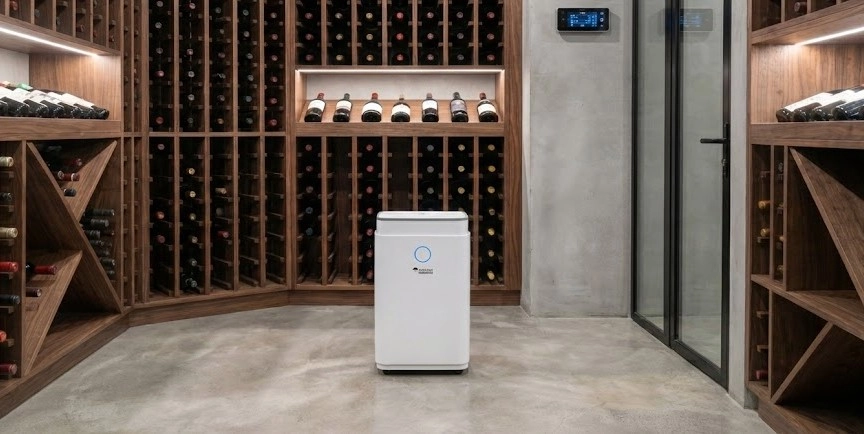
Natural cork stoppers are hygroscopic and sensitive to humidity. The optimal humidity for bottled wine storage is 60-70% RH. Below this range, corks dry out, shrink and lose their seal; above it, they can be affected by the fungus Botrytis cinerea, leading to a “cork taint” in the wine.
Brewing specifics
Brewing is characterised by a variety of process areas with different climate requirements. The brewhouse operates at high temperatures (70-100°C) and generates a significant amount of moisture due to wort evaporation. The fermentation area requires temperature control (15-24°C for ales, 7-13°C for lagers) and humidity control (50-60% RH), as well as efficient removal of CO2 produced during fermentation.
Humidity control is particularly challenging during equipment washing with CIP systems (Clean-In-Place). During a wash cycle, relative humidity can jump from 40% to 95% within minutes. A typical wash cycle lasts 45-90 minutes, and the time to restore normal humidity without special measures can be 4-8 hours.
Storage of brewing raw materials also has specific requirements. Malt should be stored at 50-60% RH to prevent mould development and loss of enzymatic activity. Hops require even lower humidity (40-45% RH) to preserve aromatic oils, and yeast cultures need controlled conditions to maintain viability.
Low-temperature psychrometry
In basement spaces with temperatures of +5...+18°C, particular psychrometric laws apply. On the psychrometric chart, the low-temperature region is characterised by an extremely small distance between the saturation curve (100% RH) and the actual air parameters. This means that even a slight decrease in surface temperature can lead to condensation.
The dew point is a key parameter for preventing condensation on the cold surfaces of barrels, tanks and pipelines. For example, at an air temperature of +12°C and relative humidity of 65%, the dew point is +5.5°C. That is, any surface with a temperature below +5.5°C will become a site of condensate formation.
It is important to understand the difference between absolute and relative humidity. As air temperature drops, its ability to hold moisture decreases, so relative humidity rises even without any additional moisture input. For example, air with a moisture content of 6.5 g/kg at a temperature of +15°C has a relative humidity of 60%, but when cooled to +10°C the relative humidity will rise to 80%.
Microbiological aspects
Microorganisms that threaten the quality of alcoholic beverages have optimal growth conditions at temperatures of 15-30°C and relative humidity above 65-70%. The concept of water activity (aw) is critically important for understanding microbial development on organic materials. Most pathogenic bacteria do not reproduce at aw below 0.91 (which corresponds to approximately 65% RH).
The main microbiological threats are mould on the walls and ceilings of cellars, cork spoilage by the fungus Botrytis cinerea, growth of undesirable yeasts and bacteria in beer (especially lactic acid and acetic acid bacteria), as well as biocorrosion of metal equipment. Historical examples demonstrate the seriousness of this problem – the famous cave paintings in the Lascaux caves in France suffered significant damage due to uncontrolled microbial growth at elevated humidity.
The relationship between humidity and sanitation is manifested in the survival time of spores and the rate of microbial reproduction. At relative humidity below 60%, most mould spores remain viable but are not activated. When humidity rises to 70-75% and above, their activation occurs within 24-48 hours.
Recommended storage parameters
The following parameters are optimal for wine cellars: ageing of red wines – 12-16°C and 60-70% RH, white wines – 10-12°C and 65-75% RH, bottle storage – 10-15°C and 60-70% RH. These ranges provide a balance between minimising evaporation and preventing microbial growth.
In breweries, recommended parameters vary by process: ale fermentation – 15-24°C and 50-60% RH, lagering – 0-4°C and 70-80% RH, filling – 4-10°C and 50-60% RH, finished product storage – 4-8°C and below 60% RH.
Permissible short-term deviations are ±5% RH for no more than 2 hours, without regular repetition. Economic analysis shows that increasing the accuracy of humidity control from ±5% to ±2% increases capital expenditure by 30-40%, but reduces product losses by 2-3%.
Dehumidification technologies
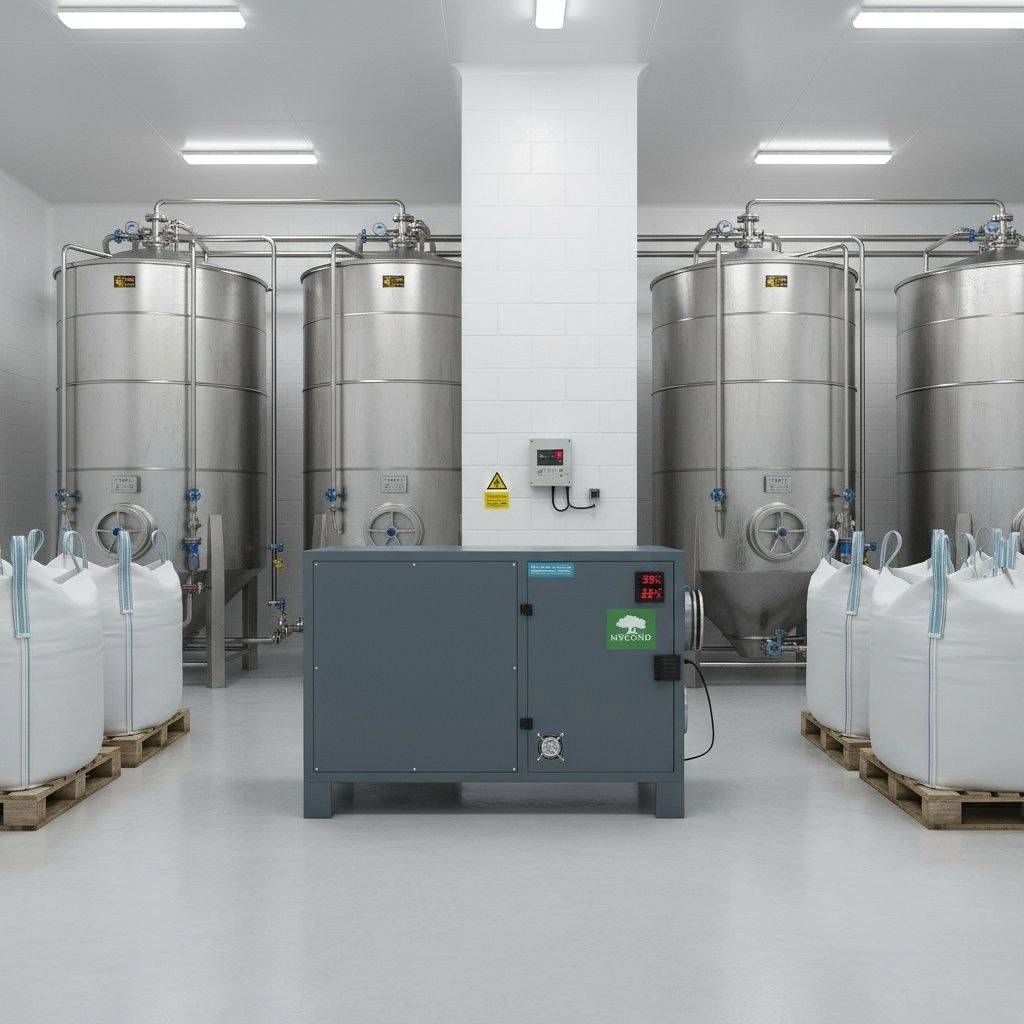
There are two main types of dehumidifiers for use in wine cellars and breweries: condensational and adsorption. Condensational dehumidifiers work by cooling air below its dew point, condensing the moisture and then reheating the dried air. Their efficiency decreases significantly at temperatures below +15°C and becomes almost zero at +10°C and lower. Their primary application is in warm rooms: brewhouses and filling areas.
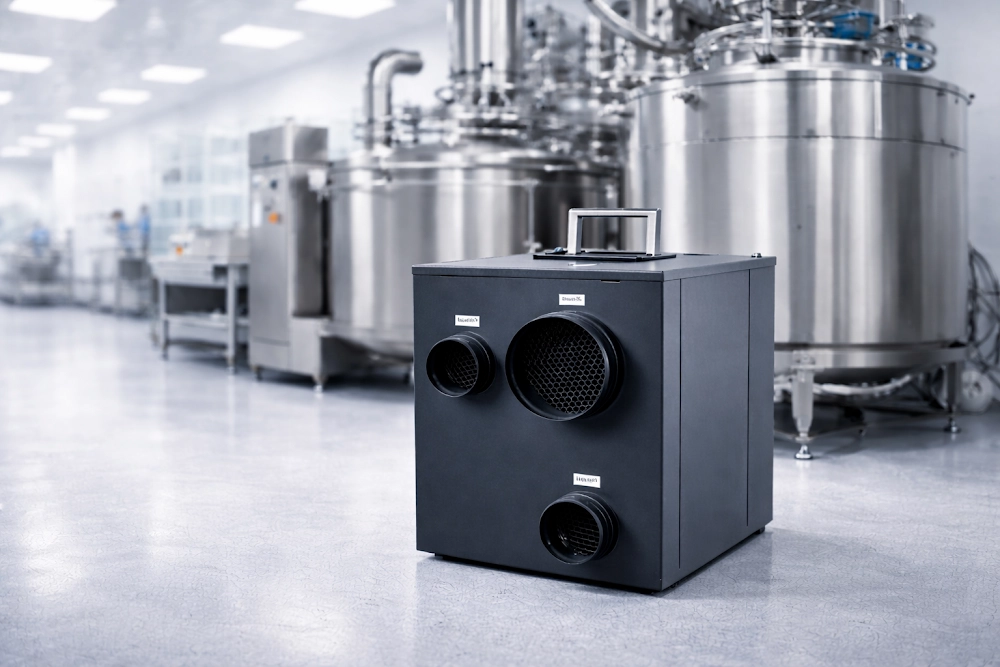
Adsorption dehumidifiers use chemical sorption of moisture on silica gel or zeolite with subsequent regeneration of the sorbent by hot air. They remain effective at low temperatures and can achieve very low dew points (down to -40°C). This makes them ideal for cold cellars and lagering areas, but they require additional energy for adsorbent regeneration.
Hybrid systems make it possible to optimise energy consumption by switching between dehumidifier types depending on season and load. For example, using a condensational dehumidifier in summer (when room temperature is above +15°C) and an adsorption unit in winter (at lower temperatures) can deliver savings of up to 25% in annual operating costs.
Common design mistakes
When designing dehumidification systems for wine cellars and breweries, certain mistakes are often made. The most common is selecting the wrong type of dehumidifier, for example, installing a condensational dehumidifier in a wine cellar at +12°C. The result is virtually zero performance and wasted investment. The correct solution in this case is an adsorption dehumidifier.
The second typical mistake is ignoring peak loads. Designing the system only for average load without considering peaks during washing leads to uncontrolled humidity for 4-8 hours after cleaning procedures. The correct approach is to install a separate peak-capacity dehumidifier or increase the capacity margin of the main system.
The third mistake is poor room sealing. Installing expensive equipment in an unsealed cellar leads to continuous infiltration of humid air and inefficient dehumidification performance. The correct sequence of actions: sealing first, then dehumidification.
The fourth mistake is incorrect placement of humidity sensors. If a sensor is installed near the dehumidifier outlet, it may read 20% RH, while condensation forms in the barrel storage area. Sensors should be placed in critical areas – the product storage locations.
Economic justification
Economic analysis of air dehumidification systems in winemaking and brewing must consider both the cost of the problems and the cost of the solution. Loss of a batch of wine due to cork spoilage can amount to 3-5% of a winery’s annual turnover. Reject beer due to microbiological contamination can cost 2-4% of production volume. Premature corrosion of equipment reduces its service life by 20-30% and increases maintenance costs.
Capital expenditure for installing a dehumidification system for a 500 m² wine cellar is 20-30 thousand pounds sterling, and operating costs are 1.5-2.5 thousand pounds per year. The typical investment payback period is 2-4 years.
Indirect benefits include improved product quality, increased equipment service life and reduced frequency of sanitation treatments. Overall, a properly designed dehumidification system increases production profitability by 2-4%.
Conclusions
Humidity control in wine cellars and breweries is a complex engineering task that requires an understanding of psychrometry, microbiology and process engineering. The correct choice of dehumidification technology depends on temperature conditions, and an accurate calculation of all moisture sources is the basis of effective design.
Adsorption dehumidifiers are the optimal solution for low-temperature cellars, and energy efficiency can be improved through heat recovery and integration with other systems. Automation and proper placement of sensors ensure stability of microclimate parameters.
Investment in humidity control systems is economically justified by preventing product losses and extending equipment service life. Humidity, alongside temperature and sanitation, is one of the key parameters that determine the quality of alcoholic beverages and the efficiency of their production.


